Showing posts sorted by relevance for query Tales from the fallen empire. Sort by date Show all posts

Tuesday, 4 May 2021

Tales From the Fallen Empire

Tales From the Fallen Empire is a setting book written by James Carpio, with Michael Curtis, Chris Lites, Colin Chapman, Mary Lindholm, Michael R. Smith, and Walter Adam Rinehart with additional contributions by Matthew Millman. Art is by Eric Quigley, Doug Kovacs, Michael Lavoie, Scott Ackerman, Alyssa Faden, Ben Morgan, Bradley K McDevitt, Darkzel, Gary Dupuis, Lenka Simeckova, Veysel Kara, and Tsolmon.  Some artwork is copyright William McAusland and used with permission. Some artwork  is copyright Skirmisher Publishing, LLC and used with permission. The publisher is Chapter 13 Press.

This is the first setting book, to my knowledge, which was produced for Dungeon Crawl Classics, and as such it is a combination of brilliance and banality in a way that is in turns frustrating and glorious.  The Endzeitgeist review was particularly focused on where the product fell short, and it is worth reading as a counterbalance to this entry.

The review is not wrong in imagining that the concepts of the setting book are more ambitious than the actual implementation is.  This came out in the early days of Dungeon Crawl Classics. and that does show. The setting is intended to be gritty, but is a bit more Lin Carter than Robert E. Howard. Some of the mechanics and ideas may have clear d20 System lineage. But there are also some good ideas, and a lot of material worth stealing and/or reworking into your home campaign.

Tales From the Fallen Empire introduces seven character classes: the Barbarian, Man-Ape (Ooruk), Marauder, Sentinel, Draki, Sorcerer, and Witch. For my money, the Sorcerer and Witch classes are the best of the lot. Sadly, there is no occupation table to create 0-level Man-Apes or Draki...again, early days. The Draki is a kind of sentient dragon/velociraptor. 

The book also includes rules for sanity and the lack thereof (Lore and Lucidity) , sea faring and naval combat (which will require a great deal of judge ruling to work, but this is DCC, right?), ritual magic, and creating magic items. You may wish to take inspiration from the examples of magic item creation, but the system itself is a lot more d20 System and a lot less Appendix N than it could be. There is a lot of meat here for ideas, even if you do not want to take the material exactly as presented.

Tales From the Fallen Empire includes five patrons, but all are given very minimal write-ups. These are Naaz-Ibhax (The Elder Eye and the Shapeless One, Chaos Lord), Tsernobog (The Tongue of Hod), A'goth-Amon (Abyssal Prince), Aakaanksha (The Granter of Pleasures), and the Horse Goddess of Shesh. At the time the book came out, any new patron information was desireable. Now, however, there are many patrons available and these beings will take a lot of work to fully flesh out. Still, they are valuable for their flavor.

The Bestiary does include useful creatures like djinn, golems, and sidhe. There is advice (and statistics!) for dogs and falcons, which are useful. There is also an optional rule, Advancing Animal Companions, which seems somewhat familiar.

The book also contains two adventures, The Slave Pens of Maxus and The Horrors of Hod, which Endzeitgeist has covered in his review. Overall, this is a book that I am glad that I have in my collection, but it is not one that I refer to often. I have never actually run a game set in this milieu, or run either adventure from the book.

1OO years have passed since Mankind revolted and slew the Sorcerer Kings of old… Now, the survivors of seven kingdoms begin to start new lives and hopes on the ashes of old. However, even as life continues, an ancient and forgotten evil stirs awaiting its moment to strike against mankind.

 Join the struggle for survival in a war-torn land where new empires arise to impose their will upon the masses. Vicious warlords fight to control territories carved out of fallen kingdoms. Imposing magicians emerge claiming the legacy of the Sorcerer Kings. High Priests of long forgotten gods and goddesses amass wealth in the name of divine right while Warrior-priests, devoted to a banished god, patrol the lands bringing justice to people abandoned by their rulers.

Within these pages is a detailed post-apocalyptic fantasy setting taking you through an ancient realm that is fighting for its survival and its humanity. Seek your fortune or meet your fate in the burning deserts of the once lush and vibrant land of Vuul, or travel to the humid jungles of Najambi to face the tribes of the Man-Apes and their brutal sacrificial rituals.

Tales From the Fallen Empire is a post apocalyptic swords & sorcery setting created for use with the Dungeon Crawl Classics RPG by Goodman Games.  It introduces new classes, setting inspired spells, new optional rules for swords & sorcery play and more.  Tighten the straps on your sandals, grab your weapon, and head forth into a land of trouble and turmoil. Adventure  awaits those foolhardy to enter the wastelands or for those who fear not the unknown. 

Setting Features

Within the campaign setting you will find:  6 new classes: Barbarian, Witch, Draki, Sentinel, Man-Ape, & Maurader.  Adding more choices for play in the setting and within the DCC RPG.

A revised Wizard Class (The Sorcerer) - A fiendish master of the arcane who draws energy from the living to perform powerful magics.

New Spells - Magic inspired by ancient Babylonian & Egyptian folklore and mythology

New Creatures - Monster befitting to classic swords and sorcery.  Battle savage dinosaurs,  ride into the unknown on a war trained moa, or match wits with the tribal man-apes of the southern jungles.

A detailed setting inspired by the works of Fritz Lieber, Robert E. Howard, Lynn Carter, H. P. Lovecraft, Roger Corman, and Michael Moorcock

Get It Here.


Wednesday, 5 May 2021

Tales From the Fallen Empire Judge's Screen


The Tales From the Fallen Empire Judge's Screen was written by James Carpio with art by Eric Quigley and Ben Morgan. The publisher is Chapter 13 Press.

This product is a zip file containing 5 different files: the cover, and multiple versions of the Judge's Screen, include a deluxe screen in both landscape and portrait format. I own several Judge's Screens for Dungeon Crawl Classics, and I am still sad that this is not available in print on heavy cardstock. I would buy it for the artwork alone. 

While most of the artwork on other Judge's Screens focuses on the gonzo, or the varied nature of Appendix N-type gaming, this one drips solid sword & sorcery. These are not just screens that would be useful as a judge - the Ready Reference Booklet has me covered there - but simply to sit across from while someone else judged. It would certainly set the tone.

Obviously, this product ties in directly with Tales From the Fallen Empire.

Tired of popping open your DCC Core rulebook to consult the Crit tables? The Tales from the Fallen Empire Judges Screen contains useful combat tables for the Dungeon Crawl Classics RPG by Goodman Games and the Tales From the Fallen Empire Campaign Setting.  The screens feature the beautiful art of Eric Quigley depicting the fallen City-State of Y'Mataar on one side and useful tables on the inside. The download includes the original three panel screens in landscape and portrait and two new screens with more information for both DCC and tales.

Get It Here!

Tuesday, 7 June 2016

A Faceless Enemy

For a while, I thought that the Dungeon Crawl Classics community had seen the last of Chapter 13 Press with their publication of Tales from the Fallen Empire.  Happily, that has proven not to be the case. A Faceless Enemy, by Oscar Rios, just hit the virtual shelves of RPGNow.

It should be noted that there is no “Compatible With DCC RPG” logo on the cover, and there appears to be no OGL section in the pdf. I am not sure what to think about that….? This is a Dungeon Crawl Classics adventure, and it clearly references the DCC core rulebook for monsters.

Anyway, the adventure is designed for 5th level PCs. As it is recent, I will give no spoilers. It is a good adventure, and although it adheres to the background from the Tales from the Fallen Empire book, it should be easy to adjust to another campaign milieu. There is a great deal of consideration as to how the decisions of the players involved can affect the set-up and outcome of different sections of the adventure. While I have not yet played through the adventure, it seems well thought out and likely to be a great deal of fun.

CAVEAT 1: There are two plot points in the adventure, where one offers an obvious (to me) solution to the other. This shouldn’t damage the adventure, although it may change part of the outcome. The second to last paragraph on page 6 may undo what is revealed on page 17. ‘Nuff said.

CAVEAT 2:  There is a LOT of interaction with NPCs in this adventure. For judges who are ready to jump into multiple roles, this is going to be a blast. Note that, while the decisions of the NPCs are important, the author is pretty damn careful to make sure that those decisions don’t derail the PCs being of central importance.


Monday, 16 October 2017

The Gong Farmer's Almanac 2017 Vol 4

The 2017 Gongfarmer’s Almanac Volume 4: Pandemonium Setting: Dark Seas, was written by Paul Wolfe. Artwork is by Doug Kovacs, Marc Radle, Mez Toons, Paul Wolfe and Old Book Illustrations. The publisher is the Gongfarmer's Local #282.

Unlike previous years' Gongfarmer's Almanacs, five volumes of the 2017 edition have an overarching theme - the roiling, ever-changing plane of Pandemonium.

"Awash in the roiling seas of phlogiston, home to alien horrors and unknown powers, the ever-changing lands of Pandemonium remain a mystery to even the most powerful of wizards and sorcerers. Few explorers choose to travel the chaos-way, and even fewer return. To most, Pandemonium is a myth, an impossible place where the land and sky are all mutable, where the land itself can be an ally or foe, and where a powerful will can transform reality." - Harley Stroh

This volume describes a single campaign setting, only nominal linked to Pandemonium. Apart from the excellent Zine Indexes by Jon Hershberger, I believe that this is the first Gongfarmer's Almanac volume produced that is the work of a single author. The material is described as a "DCC rip of Sunless Sea".

For those of us, including myself, not familiar with Sunless Sea, the author describes the setting thus:

"Far beneath a shattered world lies an underground ocean of unfathomable depths in perpetual night and crawling with ancient beasts. You are not heroes – you are sailors on a wine-dark sea, chasing the secrets of the past scribbled on ancient pages or scattered across a thousand fragments and running from the constant threat of madness. Captains of iron steamships cut across the Undersea armed with powerful carbide lamps, deck guns, and other weapons to ward off the night, as well as the creatures and pirates that lurk there. Beings of Stone, Salt, and Storm aid or hinder you, or laugh as your vessel sinks below the black waves. Out there somewhere – in the ports, ruins and wilds that cling to small rocky islands – are the formulae that could save humanity. Or doom them to lives of gibbering insanity."

This volume covers:

Optional Character Generation: Characters start penniless, only gain XP by learning and disclosing secrets, and choose allegiances to Salt, Stone, or Storm for alignment. You will need to read Appendix C to understand exactly how character generation has changed, though, and frankly should read all of the appendixes before proceeding with the adventure.

Betrayal at the Admiralty: A 0-level funnel for Dark Seas. Characters begin play press-ganged into service, but quickly assume greater responsibility on the steamship Queen’s Sword. Secrets lurk in every cranny of the ship and on every darkened rock that clings to uncertainty. Will the characters find out who threatens the Admiralty and Londonia’s sovereignty?

Judges are warned to dive into the appendixes of this volume before tackling the adventure. The adventure is flavorful, though, and does an excellent job of evoking the feel of the setting.

Locations on the Undersea: Short, evocative descriptions of places PCs may visit, with both a judge's and a players' hexmap. Paul Wolfe has done a very good job providing the flavor of each area, as well as the details that will allow a good judge to bring it to life. XP in Dark Seas works via secrets, so the author gives you plenty of examples!

Appendix M: NPCs or...So, What's the Mystery?: This appendix is really part of the adventure, but the Crime and Motive portion may be useful for judges crafting future mysteries.

Appendx C: Creating Characters: The author writes "Character creation for the Dark Seas campaign is generally the same as any DCC RPG game", but there are enough differences that this should have been a section before the adventure. Certainly, the judge will need to understand and communicate the changes to his players.

All PCs start with a contact and an initial secret ("something that the character knows that drives them to seek out more dangerous knowledge"), which replace the typical Lucky roll (birth augur) from the Dungeon Crawl Classics core rulebook. Race is separated from class, and saving throws change. While the changes to saves are mostly cosmetic, the ability to choose the highest of two stats to modify saves and the inclusion of a Terror save are significant.

Appendix S: Steamships: "Though 0-level characters start out as simple crew — often attempting to survive their first mission to uncover secrets for someone more powerful than they — upon gaining 1st level, the party receives its own steamship." 

The rules for steamships are simple, intuitive, and evocative. Importantly, terror plays a part in these rules, as does resource management, and these two elements influence each other. Eventually, someone is going to put together a naval guide for Dungeon Crawl Classics, and hopefully elements from this issue, as well as Tales From the Fallen Empire and Crawl! #11 are considered.

Appendix W&E: Weapons & Equipment: "Dark Seas is set in a fantasy Victorian/Lovecraftian post-apocalyptic place where society has retreated underground to a vast, unfathomable sea. Equip accordingly." The inclusion of Heavy damage, and fairly extensive tables for goods and cargo, are definitely welcome.

"Some targets such as ships, giant creatures, and the like, can only be damaged by heavy damage. If a character or other relatively normal-sized creature is struck by a weapon that deals heavy damage, the damage dice are trebled. Normal firearms may harm creatures that can only be injured by heavy damage — each 10 points of normal damage deals 1 point of damage to a giant sea creature. Ships and other vehicles may not be harmed by normal firearms."

The issue is rounded off with a Sample Steamship sheet, and two pages of "two-up" Dark Seas character sheets, suitable for 0-level play. Having one of these pages be a regular Dark Seas character sheet would have been ideal, but the way the pages lay in the print spread allows you to photocopy any number of four-character sheets for an introductory funnel.

Get It Here!


Friday, 10 November 2017

The Making of the Ghost Ring

DCC #85: The Making of the Ghost Ring is a 4th level adventure by Michael Curtis, illustrated by Doug Kovacs (cover and cartography), Jim Holloway, Stefan Poag, and Michael Wilson. The publisher is Goodman Games.

Disclosure: I was an uncredited playtester for this adventure.

Magic is mysterious in Dungeon Crawl Classics, and creating a magic item can be an adventure in itself. Well, more than one adventure if the judge so decides. In this case, it takes one more adventure, even after the maker has crossed over into death. And, because she cannot complete her work alone (but must complete it!) the PCs are given a chance to help.

And, should you agree, you get teleported around the world to gather the things still needed to complete the magic. As a complication, there is a demon who wishes to collect the ghostly sorceress's soul. This means that the ghost, Lifthrasir, has a time limit to meet if she is going to finish crafting the ring, and by so doing save herself.

Yes, the adventure is rather linear. It is a series of sub-quests, and is fairly (although not exclusively) combat-oriented. Nonetheless, each of the set pieces is interesting, and each of the set pieces is substantially different from the others. The PCs definitely have agency in how they deal with the subquests, and creativity can definitely affect the outcome! My players, for instance, had the easiest time with what was (I believe) intended to the most difficult set piece.

Notably, the PCs will have to leave some major treasures behind if they wish to continue their quest. In my opinion, this is a feature rather than a bug. First off, it means that the players have to make interesting choices. Second, planar step is a 3rd level spell, and the PCs may have access to it by 5th level.

Overall, this adventure is reminiscent of Gary Gygax's advice about creating magic items in the 1st Edition Advanced Dungeons & Dragons Dungeon Master's Guide. For instance:
Harvest the pumpkin in the dark of the moon and dry the seeds over a slow fire of sandalwood and horse dung. Select three perfect ones and grind them into a coarse meal, husks and all. Boil the basilisk eye and cockatrice feathers for exactly 5 minutes in a saline solution, drain, and place in a jar. Add the medusa’s snake venom and gem powders.Allow to stand for 24 hours, stirring occasionally. Pour off liquid into bottle, add sepia and holy ,water, mixing contents with a silver rod, stirring widdershins. Makes ink sufficient for one scroll.
There is a great deal more flavor to this sort of process than there is to, say, a list of spells, feats, and a cost in gold pieces!

(For another take on creating magic items, see Tales From the Fallen Empire.)

To save a soul and forge a ring! A ghostly enchantress calls for aid, her salvation hanging in the balance. Brave heroes are needed to complete the creation of a magical ring, a process that will take them from gritty city streets to sun-scorched deserts to the ruins of an ancient fortress atop a windswept peak. Are the adventurers up to the task or shall a sinister demon claim the souls of not only the enchantress but the heroes as well? Only luck, courage, and wits will triumph against adversity and allow the adventurers to claim the Ghost Ring for themselves!

Get It Here!


Sunday, 27 December 2020

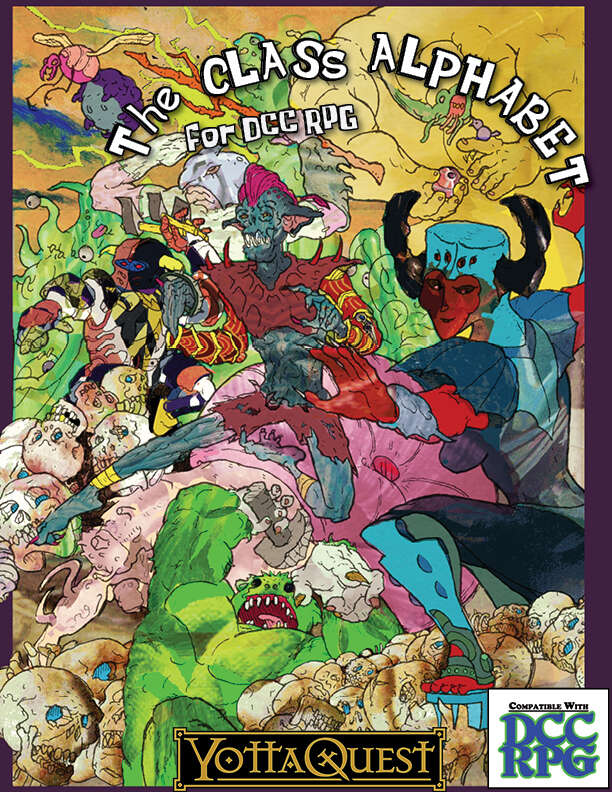
The Class Alphabet for DCC RPG

The Class Alphabet for DCC RPG was written by James V. West, Stephen Murrish, Anne Hunter, Victor Garrison, Jarrett Crader, David Baity, Julian Bernick, R.S. Tilton, Wayne Snyder, Claytonian, Diogo Nogueira, Noah Stevens, Jose SeldanaDavid Coppoletti, Jeff Goad, Jon Wilson, Reid San Filippo, Justin IsaacForrest Aguirre, Terra Fox, Anna Costa, and Rick Kammer. Art is by Danny Prescott, James V. West, Davey Parrott, Jane Elisabeth Thomas, David Coppoletti, Evlyn Moreau, Jon Wilson, R.S. Tilton, Claytonian, Diogo Nogueria, KJ O'Brien, David Lewis Johnson, Ray Otus, Karl Stjernberg, Anna Costa, and Rick Kammer. The publisher is Dungeon Remixer.

Disclaimer: I was given a free pdf from the publisher, in hopes that I would write about this product (which I would have anyway). As a result I noticed a few small edits prior to publication, which resulted in my being given a credit as an editor. My blog, Raven Crowking's Nest, is listed in Appendix III of this work.

This book, not surprisingly, contains an Introduction and a "How to use this book" section. Each is a single page long. Not all of the classes herein are going to fit well into every campaign. With 26 classes to choose from, the odds are that something will fit into any given milieu. None of these classes, however, is simply a Ranger or Paladin variant. Well, there is the Zealot....

For some reason, the publisher decided to make the pdf not only automatically default to a two-page spread, but treated those spreads as single pages. This is not ideal. Obviously, the two-page spread looks good - most pages are designed to take advantage of how one would see the pages in print - but it does make reading the pdf harder than it needs to be. At the point of this writing, a print version is not available.

Let's take closer a look at each of these classes, shall we?

A is for APE ASCENDANT: You are an ape. You are a very smart ape. You are a smart ape with primal strength and rage. You are a very smart ape with primal strength and rage that can deliver powerful psionic blasts. If you wanted to play an analogue of Gorilla Grodd, this is your chance. This is a relatively simple class to understand, taking only a single page of the book.

This class would fit into any tropical milieu with a bit of gonzo, but the PC might have a harder time visiting a tavern. This could also stand in for a yeti-type character, or a subset of Ith’n Ya’roo.

B is for BLACK CAT: Literally a magical black cat, this is nonetheless a fairly complex class which takes a full 12 pages to describe fully. The Black Cat gains spells, its own unique critical hit table, and a full patron write-up for Shammat, Lady of Cats. 

Most campaign milieus will include cats, and most societies are not at all surprised to see cats hanging around where people are. This class could gain wide usage as a result. Shammat might be an interesting patron for wizards and elves.

C is for CYBER-ZOMBIE: This class represents a dead body reanimated and upgraded with technology. Characters have to die in order to become Cyber Zombies, and not every dead character can be revived as such.

This is a complex character class that requires 7 pages to describe, including upgrades that the character might gain. In a milieu similar to Umerica or Mutant Crawl Classics, this class could fit right in. The class might be the result of PC action, or the result of technological processes beyond the characters' control - in this way, an adventure location could create Cyber Zombies as unique PCs even in a nominally medieval setting.

D is for DRUG USER: I am still amazed that Joseph Goodman let this one into the book.

A complex class taking 10 pages to describe, "You sacrifice your sanity to forces from beyond the cosmic veil in exchange for powers unknown in your birth universe. You walk a tightrope between controlling your environment and controlling yourself. If you let your guard down for just one unwary moment, or pursue an ecstatic experience just a little too far, you risk being invaded and ultimately consumed by Transdimensional Cognitive Parasites who skitter around the periphery of your reality, looking for a portal into a host consciousness in your dimension".

Ostensibly, this class could fit into almost any game setting, but including it will definitely change the tone of a campaign. Sadly, there is no mention of taduki.

E is for EDITOR: Taking up two pages, this class is designed with meta-gaming in mind. Serious meta-gaming. As in looking at the judge's notes and reporting back to the party meta-gaming. This might be fun in a one-shot, but I would have a hard time using it in an extended campaign. What else should one expect from "Jarrett Crader & accomplices"?

F is for FLESH-FORGED: This is a two-page re-imagining of Frankenstein's Monster, with an awareness that all of its parts might not actually be human. The class is relatively straight-forward and could fit into almost any milieu. With a little bit of disguise work, it might even be welcome in a tavern. I would limit the use of the class to prevent it from losing its impact.

G is for GOBLIN GANG: Another two-page class, you are literally a gang of small, imp- or gremlin-like goblins. Effectively, this is role-playing a swarm. Does it work? Well, the class is not difficult to understand, but it would have a hard time interacting with the mundane folk of your average village.

It would be easy to reskin this class to fit into almost any campaign milieu, although if the game is strongly human-centric it will not fit. They could be some form of collective intelligence in Star Crawl, Crawljammer, or Phantasmagoria. In Umerica or Mutant Crawl Classics, they would fit right in. In a game based around the Shudder MountainsDark Trails Weird Frontiers, or Transylvanian Adventures this class could represent an opponent, but probably will not be a comrade-in-arms.

H is for HELLFONT: Why allow wizards to have all the fun of demonic patrons and corruption? Now your Warrior-type character can have them too! Although not a complicated class, it does take 4 pages to also document the powers and corruptions you might have. I picture this class as being inspired by Venger from the old Dungeons & Dragons cartoon, but I could certainly be wrong.

If there are demonic patrons in your milieu, this class will fit. You might have trouble mingling with other folk, however,

I is for INTELLIGENT WEAPON: Here is an interesting idea: your PC is an intelligent weapon. This also means that you need a thrall...some feckless would-be adventurer that you can control and act through. It is a neat idea, taking three pages to detail, and is not overly complicated. Although a magical sword, axe, or hammer might be the go-to ideas that come to the average player, it would be easy to use this class in Mutant Crawl Classics, Star Crawl, or Umerica with a more technological base. Not every magical ability is easily converted to a technological ability, but transition should go smoothly with a little judicious interpretation.

J is for JOCKEY: This is a one-page class for those who might wish to ride some form of critter. It isn't complicated and, for the most part, it should translate easily to almost any game milieu. If  the idea of a PC mounted on an umber hulk is too gonzo for you, use sparingly!

K is for KNAVE: This is possibly the most complex class created for Dungeon Crawl Classics at the time of this writing. It is not surprising, then, that it takes a full 30 pages to fully describe. 

"Knaves are selfish in the extreme. They take what they want, and live off other people’s labor. Knaves take the largest slice of pie; they drink the whole pail of water. Knaves want the biggest and the best, the first pick, the choicest cut. They demand service and servitude, and anyone who stands against them gets beaten down full sore. Knaves blackmail and ambush, they burgle and break, they wheedle, they scheme, and they’ll fight to the death – but never lift a finger to do an honest day’s work."

What sets them apart, though, is service to the Arcana. The Knave has a mystical relationship to the tarot deck, They have a suit chosen from those of standard playing cards - Clubs, Spades, Diamonds, and Hearts - that helps to define their powers. In short, once more, they are complicated. Flavorful, but complicated. You will want to have this section printed out at the table if you play a Knave or have one in your game. 

Depending upon how your magic is styled, this class may or may not fit into your milieu. It would be perfect in a game inspired by Faerie Tales from Unlit Shores, but might seem out of place on the Purple Planet. Or not. It's your game.

L is for LEMURIAN: Another ape-themed class, this one being a man-ape with ancient memories but no overt psionics. Well, the picture shows a man-ape, but this could just as easily describe Brule the Spear-Slayer from Robert E. Howard's Kull stories, or some of the heroes of Lin Carter's more tongue-in-cheek Lemurian Cycle. The class is not complicated, clocking in at three pages. If your milieu includes ancient peoples in a primordial world, the Lemurians may do nicely.

M is for MONSTER TRAINER: Clearly inspired by Pokémon, this somewhat complicated class only takes three pages to describe. Unfortunately, the sample monsters from the Working Class Alphabet are not reproduced (so you had better get that as well...) but, then, anyone travelling in a DCC milieu is bound to encounter something worth catching.

Because of the obvious source of inspiration, this class might not fit into all milieus. However, the writing is good, and the class could fit into almost any game. 

N is for NINJA VAMPIRE: You are a ninja. You are a vampire. It takes two pages to describe what this means, because, after all, "Ninja Vampire" is not a hard concept to grasp. Whether or not your character fits into a particular campaign milieu is another matter. This class is particularly appropriate appearing in the ruins of Seattle in an Umerican campaign.

O is for OGRE: You are an ogre. It isn't that complicated. Your class takes three pages to describe because you get your own special crit table. You get that table because you are big and you like to bite things. There are probably a lot of campaign milieus where you can't get seated in a tavern.

P is for PUPPET MASTER: This class casts spells and controls puppets, which makes it rather like the villain of A. Merritt's Burn, Witch, Burn! This is not very complicated, but takes 3 pages to describe because the puppets themselves must be described. This class could fit into most settings.

Q is for QUANTUM WANDERER: "You are misplaced in time and space — lost, marooned, or simply not where you started — but in any case, you come from a world very different to the primitive one you find yourself on now. Though it must be said these primitives do keep finding ways to surprise you with their inventiveness. You may be moving on as soon as your etheric beam emitter is working again and your towel is dry, or perhaps this is where you’ve decided to settle long term. Or you may be searching this world high and low, in hopes of finding a way back to where you belong..."

This class takes three pages to describe and assumes that the PC comes from an advanced future. Appendix N fiction is filled with modern people become embroiled in other worlds, be they the past of their own world, or other worlds such as Mars or Venus. Here we are more into Kang the Conqueror or Booster Gold territory.

R is for RO-BARD: This is a robot entertainer. Although the class uses standard DCC class metrics, this is clearly a class that would fit well into the Umerican setting. It might also fit well in Star Crawl, Phantasmagoria, or Crawljammer. Not overly complicated, the class takes 3 pages to describe.

S is for SLIMENOID: A simple, single-page class that is also not likely to be welcome in the average tavern. "Mucal invader, is there no end to your oozing?!" Strangely, though, I could see this class working in most campaign milieus. In some, the Slimenoid would be an anomaly, but in a Mutant Crawl Classics game? Slime on!

T is for TENACIOUS D-FENDER: This is a three-page class dedicated to Tenacious D - effectively a parody of a parody. Nonetheless, it is a playable class...although playing one will very likely affect the tone of the game.

U is for UBIQUARIAN: "Everyone has wished they could be in two places at once, but the ubiquarian actually can—and some can even be in up to sixteen places at once!" It's an interesting idea for a class, and one that could fit into a great many campaign milieus. The class is not overly complex, and takes up three pages including a table for Astral Mishaps. Probably more importantly, the rules allow the class to do some unique things - including providing advanced scouting - but it should not overwhelm the table.

V is for VELOCIRAPTOR: A two-page description of a Velociraptor class. For other takes on similar classes see The Goodman Games 2017 Gen Con Program Book, Crawling Under a Broken Moon #14, Hubris, and Tales of the Fallen Empire. DCC players seem to have a thing for playing saurians. They are even part of Primal Tales.

W is for WOLF GIRL: "Bristling with primal energy, finely tuned to her territory, thriving on self-governance—the Wolf Girl is an unapologetic autarch, motivated by razor sharp instincts and a ferocious drive to survive. Her prevailing ideology is essentially solipsistic: preservation of self, and of the environs that sustain her. Threats to this paradigm are dispatched with swift brutality. Depending on her natural empathy, a Wolf Girl’s sense of self can expand to include friends and causes, which she will defend with exceptional displays of courage and sacrifice.

Wolf Girl has an inner wolf; she is a shifter, dominated by mood swings, focused anger, and unresolved trauma. Residing in the wild, she and her lupine companion are self-possessed, meditative, and stunningly savage. 

A Wolf Girl might use her connection with the earth to craft potent medicines, bezoars, and alchemical components. She might also be a master of her physical reality: platforming buildings, deflecting gunfire, and lancing targets from hundreds of yards away. Wolf Girl’s origins and motivations differ as well. The Wolf Girl is a paragon of natural balance."

This is a magical female Mowgli which takes two pages to describe. The Wolf Girl would fit into most campaign milieus, but would excel at outdoor adventuring away from the confines of both the city and the dungeon.  

X is for XENOCYTE: A two-page class that seems a bit Alien. There are game milieus into which this would fit (Star Crawl springs to mind), but I have a hard time imagining Xenocytes mingling in the tavern after an adventure, or carousing on the streets of Lankhmar.

Y is for YOUTHFUL MUSICIAN: "In every age, in every land, there have been those good souls who travel amongst the needy and who work to undo the machinations of evil. There is something about youth, exuberance, and transgressive music that stirs adolescence and young adults into travel and the championing of all that is good and right. Often, these foolhardy souls simply strive to right the wrongs caused by petty men and women against their neighbors, but every now and then they stymie the efforts of galaxy-spanning cults, supernatural beings, and weird entities from beyond the stars. They fight the good fight for the sheer reward of it, asking no recompense and wandering here and there living where the needs of Law might take them. They tend to attract weirdness of all kinds, and are frequently accompanied by talking animals, beneficent spirits, barmy obsolete robots, and all manner of other companions. Playing music is something of a side gig, or perhaps solving mysteries is the side gig - often there is no way to tell..."

This two-page class is inspired by Jeff Quick’s game Hijinx, appearing in Polyhedron #158. It is a joke class, like the Hot Dog Suit, which will definitely alter the tone of whatever game it appears in.

Z is for ZEALOT: The last class in the book is a two-page divine champion which is definitely promoting a single god. This should fit easily into most campaigns.

Appendices: The book also includes three appendixes. The first deals with esoteric rules and frequently asked questions. The second breaks down the classes into the in-game roles they fill. A discerning judge might reproduce the list from this chart to indicate which options are available in their game. An even more discerning judge might allow certain classes to become available as rewards for meeting certain Quest For It goals, or for playing through specific adventures. Finally, there is an appendix of resources, including an Alphabet of Game Worlds.

The Class Alphabet for DCC RPG introduces 26 NEW classes to your game. Each is fully playable from level 1 to 10, and there's a class for every letter of the alphabet! Within this book you will find a mythic proportion of options for any variety of game setting or playstyle. Every class has been lovingly handcrafted and lavishly illustrated by a team of gongfarming gamers from every corner of the globe. These classes will not only elevate your game to new heights of gonzo-infused frenzy, but will also inspire a multitude of ideas to help judges and players develop their own unique content.

Apes, robotic bards, quantum vagrants, shadow manipulators, monster trainers, puppet masters, ogres, dinosaurs, hellbound warriors, tenacious d-fenders, and gangs of goblins are JUST A FEW of the madcap character classes you'll discover inside. All completely illustrated with accompanying spells, crit tables, powers, and other bizarre tables of options.

Strap in, because your game is about to experience a paradigm shift and things may never again be the same!

Get It Here!