Showing posts sorted by relevance for query unlit shores. Sort by date Show all posts

Tuesday, 10 October 2017

The Gong Farmer's Almanac 2017 Vol 2

The 2017 Gongfarmer’s Almanac Volume 2: Pandemonium Locations, Part I, was written by Marc Bruner, Jeff Goad, Keith Nelson, SGT Dave, Dan Steeby, and Harley Stroh. Artwork is by Doug Kovacs, Marc Radle, Patrick Regan, Clayton Williams, and William McAusland. Cartography is by Alden Bruner, Marc Bruner, Bobby Jackson, SGT Dave, and Shyloh Wideman. The publisher is the Gongfarmer's Local #282.

Unlike previous years' Gongfarmer's Almanacs, five volumes of the 2017 edition have an overarching theme - the roiling, ever-changing plane of Pandemonium.

"Awash in the roiling seas of phlogiston, home to alien horrors and unknown powers, the ever-changing lands of Pandemonium remain a mystery to even the most powerful of wizards and sorcerers. Few explorers choose to travel the chaos-way, and even fewer return. To most, Pandemonium is a myth, an impossible place where the land and sky are all mutable, where the land itself can be an ally or foe, and where a powerful will can transform reality." - Harley Stroh

This volume describes some of the hexes of Pandemonium. Let's look inside.

The Big Rock Candy Mountains: If, like me, you enjoyed O Brother, Where Art Thou?, you might be expecting a different description of the Big Rock Candy Mountains! In Pandemonium, this is a form of Candyland where children become sugar thralls (or worse). Monsters resemble well-known children's games and confectionery treats, but author Jeff Goad displays a wickedly twisted sense of humor, and doesn't leave it at that. This hex could easily be used in conjunction with Faerie Tales From Unlit Shores, Perils of the Cinder Claws, or Lamentations of the Gingerbread Princess.

The Big Festering Giant: Perhaps you think BFG stands for Big Friendly Giant? Perhaps not to be outdone by Jeff Goad in twisting childhood memories author Keith Nelson introduces the Big Festering Giant, a colossal near-corpse that you can squick about inside. This is actually a lovingly rendered text of a rather unlovely subject, and includes the rather interesting Among the Mite-Goblins on the Shores of Lake Urine: An Introductory Encounter to the BFG.

Monsters of the Big Festering Giant: Keith Nelson also includes "a brief selection of the mundane and bizarre inhabitants and active perils of the creature colloquially known as the Big Festering Giant, or BFG." A full dozen monsters are listed, some with varieties thereunto. Here are some encounters I worked on, which might also be usable in the BFG.

The Black Iron Citadel: Dan Steeby offers a scorched desert cavernscape, dominated by a "massive structure with the shape of a colossal humanoid form, seemingly crouching in a pitiful, cowering position, with massive arms thrown over its tusked face as in a final ward against its doom." This is the Black Iron Citadel, ruled by the demon prince Pazuzu. PCs may also meet his "supremely bored and petulant" daughter, Lilitu.

The Boreal Wastes: This hex, by Harley Stroh, with additional material by Marc Bruner, is exactly what it sounds like: a vast icy wasteland with enormous ice ridges and ruins half-buried in the snow and ice. Most of the hexes thus far have been based on twisted childhood themes or hellscapes, so the Boreal Wastes come as a nice change. I am left wondering whether some of this material was unused from the beginning of Journey to the Center of Áereth?

The Carousel of Doom:  This hex, "a mutated carnival of insanity, guilt, and agony" also deals with childhood themes. It also includes platypus cultists and marsupial face huggers, so a good time is sure to be had by all. If your players visit this hex of Pandemonium, be sure to thank SGT Dave, the writer, for delving into the Ruins of Make-believe.

The Forest of Nedra: Finally, Marc Bruner offers "A shadow land of grey twilight" existing "between states of reality, filled with objects both half-formed and those seemingly etched into the fabric of creation itself." A faerie-based hex, this has a Dark River that strongly reminds me of the enchanted stream through Mirkwood in The Hobbit. A portal could easily link this hex to Goblins of the Faerie Woods or the Goblin Market in Creeping Beauties of the Wood. Or both.

Get It Here!

Thursday, 22 September 2016

Creeping Beauties of the Wood

Creeping Beauties of the Wood is the second module in the Faerie Tales From Unlit Shore series, written by Daniel J. Bishop and published by Purple Duck Games.

Disclosure: I am the writer.

This adventure follows Prince Charming, Reanimator, and gives the PCs the opportunity to deal with the loose ends from that adventure. In addition to the Sleeping Beauty, they are confronted by Prince Charming's two previous un-dead wives, Snow White and Cinder Ella.

The adventure is largely a hex crawl, but there are four important locations that break this up: the hiding places of the three un-dead wives, and the Goblin Market. During playtests, the Goblin Market was so alluring to my players that we easily spent the greater part of a game session interacting with it, and the players went out of their way to have their characters return.

The adventure includes two patrons: Doctor Chapman and Hizzzgrad, Daemonic Lord of Crawling Things. In the terms originating in Silent Nightfall and used in Angels, Daemons, and Beings Between: Expanded, Otherworldly Edition, Doctor Chapman would be a demi-patron. Hizzzgrad is given a full write-up, and is reprinted in the expanded edition of Angels, Daemons, and Beings Between. An effort is made to give the PCs reason to work with Doctor Chapman, and potentially choose him as a patron.

The adventure also includes a new race-class: Faerie Animals. These are, essentially, animals which can take human form and which may learn a bit of magic as they gain levels. The faerie animals described herein are suitable for the Grimmswood location; a table for the region around Portsmouth is provided for The Portsmouth Mermaid.

While this adventure makes use of traditional fairy tale motifs, it also makes reference to the works of Frank Baum, Lewis Carroll, and Christina Rossetti. There are Appendix N references worked into the text as well, although these are not as overt as in Prince Charming, Reanimator or The Portsmouth Mermaid. I hope they bring some joy to those who notice them.

Because the Faerie Tales From Unlit Shores series takes place in a persistent milieu - the events of one adventure have real effects on those that follow - your PCs may enter the Grimmswood many times over the course of their adventures. Even if, say, they fail to encounter Nick Cutter, the Iron Axeman, on their first outing, placing additional adventures in and around the region is certain to give them the opportunity to do so.

Get It Here.


Wednesday, 14 February 2018

Prince Charming, Reanimator

FT0: Prince Charming, Reanimator is a 0-level funnel adventure written by Daniel J. Bishop. Art is by Luigi Catellani, and cartography is by Kristian Richards. The publisher is Purple Duck Games.

Disclosure: I am the author.

This product comes about due to the confluence of several factors.

First, I had planned to do a series of fairy tale-based adventures for the Dungeon Crawl Classics RPG, titled Faerie Tales from Unlit Shores. The idea was to combine classic fairy tales with one or more strong Appendix N influences, to create something that accentuated the folkloric (and often dark) fey elements of the original tale and the adventurous energy of Appendix N fiction.

Second, my good friend Raechel Henderson, who was the first person to ever pay me for a piece of writing, had a Kickstarter project that was moving slowly. I asked my readers to help spread the word about Raechel’s project, in return for which I would write a free adventure. Her project, Spellbound and Spindles, was related to fairy tales too, making this a perfect tribute to those who contributed either with dollars or links. Although Spellbound is no more, it pleases me to no end that Raechel Henderson not only achieved her goal, but fulfilled her commitments, releasing seven issues before Spellbound closed its doors. Perhaps, like Sleeping Beauty herself, Spellbound will reawaken at some future date? Our community should all wish for a strong introduction to fantasy specifically made for children.

Finally, Mark Gedak of Purple Duck Games not only agreed to publish the follow up series of fairy tale-based adventures, but also to publish the free adventure professionally.

The result was Prince Charming, Reanimator, with the pdf version being Pay What You Want. Prince Charming, Reanimator, is based off of the observation that Prince Charming's brides were found (in the original fairy tales) at the bottom of a well, in a glass casket, and after being "asleep" for a century. This struck me as being more than a little akin to something a medieval Herbert West, Reanimator might be into. And et voila! Here we are.

The adventure includes Dr. Chapman as a patron, using the abbreviated format from the core rulebook (invoke patron results only). For a more complete write-up, see FT 1: Creeping Beauties of the Wood.

Get It Here, or Get the PWYW Pdf Here!

Monday, 20 June 2016

The Age of Undying

That is not dead which can eternal lie, 
And with strange aeons even death may die

- H.P. Lovecraft

Tim Callahan's The Age of Undying takes you into those strange aeons, where PCs simply do not die. Nor does anything else. And if you think that means the PCs are in less danger, think again.

This is not an adventure, but is rather a zine-sized sourcebook for running adventures where nothing dies. It can be used in conjunction with any other adventure, or series of adventures. It discusses how such an Age might come to be - either through the action of the PCs (as in the author's home campaign) or otherwise.

From nastier critical hits to the effects on classes, Tim Callahan covers everything you need.

The value of The Age of Undying is greater than simply running the strange aeon itself. Parts of this work may be useful if you are running an undying PC gained via The Imperishable Sorceress, or to make Laro Chelle the Ring Bearer a larger (or more dangerous) campaign arc. Running Faerie Tales From Unlit Shores, the judge could pen an encounter where Death itself is captured, as in The Soldier and Death.

Likewise, the Age of the Undying may be global, local, or whatever the judge deems best. In a Crawljammer campaign, the Age may affect a single world or the entire system. In any campaign, it may affect a single plane of existence, or all planes of existence.

Get It Here

Tuesday, 19 October 2021

Three Nights in Portsmouth

FT 2.5: Three Nights in Portsmouth is a series of three short 2nd level adventures written by Daniel J. Bishop. Art is by Matt Morrow (cover),  Kristian Richards (cartography), and Luigi Castellani. The publisher is Purple Duck Games.

Disclosure: I am the author.

This product offers three short adventures that can be sprinkled into, or occur separately from, FT 2: The Portsmouth Mermaid. The adventure came about largely for two reasons. First, I had intended to include a dragon in each installment of the Faerie Tales from Unlit Shores series, and I had failed to include one in FT 2. Secondly, there was a lot more to explore in Portsmouth. If your players are anything like mine, at the very least they will want to rob some graves, and having something planned when they visit the Overlook is a good thing.

The adventure contains three scenarios:

The Open Tomb takes care of the most pressing question a judge might face in Portsmouth - what if the players want to go grave robbing? There are homages herein to Peter Pan, as well as the potential to run into worse things. The name "Grimperrault" is a combination from the Brothers Grimm and Charles Perrault.

The Trail of the Rat is my own take on The Pied Piper of Hamlin, with ghouls and a little added nastiness in terms of a choice the PCs must make. No one makes it out of this adventure without making some form of alliance, and some form of enemy.

Blood for Cthulhu! makes use of several fairy tales themes and creatures while crossing the salt marsh, but ends with a scene straight from The Call of Cthulhu. Depending upon how successful the PCs are at preventing the titular sacrifices, the final encounter may be easy...or close to impossible. For added tension, make that PC whose player couldn't make it tonight one of the potential victims....!

If you are not using Portsmouth, these scenarios can easily be adapted to any urban environment.

You can read an Endzeitgeist review here.

Get It Here!

Monday, 6 March 2017

Bride of the Darkened Rider

Bride of the Darkened Rider is a 3rd level adventure by Kim C. Frandsen. Rick Hershey is listed as an artist on RPG Now, but the illustrations appear to be public domain images. Bride of the Darkened Rider is published by Fat Goblin Games.

Disclosure: I was given a chance  to write for this imprint, which I had to decline because the offer conflicted with other writing commitments.

Right upfront, this adventure piqued my interest with an appropriate quote by the estimable Robert E. Howard. On top of which, the public domain illustrations come from collections of fairy tales and legends, as far as I can tell, making this adventure easy to slot into the world of Faerie Tales from Unlit Shores. That was, in fact, one of the reasons that I declined the offer, as I feel rather honor-bound to send further fairy tale-inspired manuscripts to Purple Duck Games until the FT Series is complete.

The author does a good job making use of fairy tale elements, and does an excellent job of using the "death throes" advice in the Dungeon Crawl Classics core rulebook to make opponents have a final surprise. There are a number of pieces in the adventure that are quite flavorful. The author also includes a number of vignettes which demonstrate something of day-to-day life in the adventure setting. The monsters encountered are flavorful, and definitely hit the "make monsters mysterious" mark.

Writing to make the work fit pre-existing art is rather like writing sonnets when compared to writing free verse. I think that Kim Frandsen did a good job of linking art to words, so that the art actually compliments the adventure.

I should also mention that this adventure includes a complete new patron, Morketh, Lord of Darkness and Unspoken Pleasures. Morketh does not have patron spells, but rather grants an extra spell slot when client wizards can gain 1st, 2nd, and 3rd level spells.

For all that, there are some problems with this product, and you should be aware of them before purchasing. First off, this is a really medieval adventure that uses some jarring modern parlance. Par for the course with a lot of adventures, I know, but when a dryad suggests "We better go up and check it out" or a minstrel doesn't know where the dark knight "originally worked", it jars with the tone of the rest of the adventure.

Secondly, the adventure really, really needed another editing pass. Minor glitches abound, but there are places where a lack of editing drops parts of sentences or makes it more difficult than necessary to understand what the author intended. At one point, your PCs enter a combat encounter with three individuals, only one of whom has a statblock (p. 19). The editing also damages the utility of the unique patron, as his first spellburn entry is incomplete. There is a poison that does more damage to you if you succeed than if you fail; I imagine that the damage on a failure is intended to be permanent, while the other is temporary?

Third, I am not sure how much Dungeon Crawl Classics the author has played, but the spellburn table for Morketh, while flavorful, will need some work to match the framework of spellburn in the DCC rules. Similarly, while most examples of patron taint in the core rules (or other sources) have three levels of most taints, so that if rolled again, the effects become more severe, the client wizard of Morketh gets off somewhat easily. I would also imagine that more play experience would have increased the difficulty of the fights for 3rd level adventurers considerably. I would be happy to throw this adventure, as written, at 1st level adventurers. Against 3rd level PCs, you may wish to beef up the opposition.

Finally, although the first half of the adventure as written is very linear, I imagine that as played, the linear parts will go by quickly enough not to bother the majority of players. Some of the linear material could have used more detail - for instance, what if you refuse to help the dryad? What boons can the old wizard on page 17 give PCs who befriend him (i.e., who are looking to learn spells)? What if they decide to kill him and take his stuff? What is his name? Is there any benefit to becoming the dryad's lover? I ask these questions because I know that they are the kinds of questions that players ask, either directly or indirectly through their actions at the table.

Because this is currently pdf-only, a lot of these issues could be cleaned up before (hopefully) a print version appears. There is more than enough good stuff here that I am glad that I bought it, but if the aforementioned problems were addressed it could be stellar.

EDIT: Many problems were fixed prior to print, but the cut-off table in the patron listing is sadly still there.

Here's hoping for a long and prosperous product line!

Get It Here!

Thursday, 8 February 2018

The Portsmouth Mermaid

FT 2: The Portsmouth Mermaid is a 2nd level adventure written by Daniel J. Bishop, with art by Matt Morrow (cover) and Luigi Castellani. Cartography is by Kristian Richards. Additional writing by Godric McKellan and Bobby Ree. The publisher is Purple Duck Games.

Disclosure: I am the author.

An invitation to a wedding, and a patron's desire for a mermaid's tears, bring the PCs to Portsmouth, an amalgamated not to H.P. Lovecraft's fictional towns of Kingsport and Innsmouth. In particular, judges would be well advised to read The Festival, Dagon, and The Shadow over Innsmouth if they are interested in direct influences.

The Little Mermaid, by Hans Christian Andersen, is another obvious inspiration. So much so that I am left wondering whether or not Lovecraft had considered this tale when penning Dagon.

There are a great many other fairy tale and nursery rhyme references in the adventure. The Golden River, it may be noted, relates to The King of the Golden River (by John Ruskin), and is also connected to Bone Hoard of the Dancing Horror through the "The Steadfast Tin Soldier" encounter in Appendix C: Additional Encounters.

The adventure includes five appendixes.

Appendix A is compiled statblocks for everything referenced in the adventure. There are a lot of elements that can be in play, so this is worth printing out and keeping handy.

Appendix B is New Magic Items. In August of 2014 I ran The Scrimshaw Rod contest on my blog, and decided to split the difference, declaring both contestants (Godric McKellan and Bobby Ree) winners. These items were created by them, and they should have been credited in the text.

Appendix C contains Additional Encounters that can be used to liven up adventuring in Portsmouth, either during this adventure or later in a campaign. They are The Dancing Shoes, The Steadfast Tin Soldier, The Match Girl, I Do Not Like Thee Doctor Fell, The Sky is Falling, The King of the Cats, and Simple Simon's Catch.

Appendix D: The Esoteric Order of Dagon contains a complete patron write-up for Dagon, which can also be found reprinted in  Angels, Daemons, & Beings Between: Extended, Otherworldly Edition. (In fact, there is a Dagon cover.)

Appendix E: Faerie Animal Types for Portsmouth supplies a table for faerie animal characters, using the rules in Creeping Beauties of the Wood, but which are more suitable for the Portsmouth area.

This is the third item in the Faerie Tales from Unlit Shores series. Additional supporting materials can be found in Crawl! fanzine #11 (The Deep Elders) and Three Nights in Portsmouth.

The Portsmouth Mermaid takes place over the twelve days of a Yuletide Celebration in the town of Portsmouth, north of Westlake. The adventure is largely political, with several factions, all of which have a different optimal outcome. The PCs have to figure out what is going on, decide what to do about it, and then live with the consequences.

Get It Here!


Wednesday, 10 May 2017

The Headless Horseman

The Headless Horseman is a 2nd level adventure by Oliver Korpilla. Art is by Bernd Jans, Earl Geier, Michael Scotta, Elizabeth Porter, The Forge, Bradley K. McDevitt, and Gary Dupuis. The publisher is Mount Parnassus Games.

This adventure uses the Effect Engine System (author Sarah Newton). The link to the EES SRD in the product is broken, but it seems to be a method for organizing information within an adventure so that it can be accessed and used by the Game Master in a quick and easy fashion.

If so, it is an unmitigated success in this adventure.

(Yes, in Dungeon Crawl Classics the Game Master is the Judge, but the Effect Engine System is not game-specific.)

The storyline here is excellent, without being in any sense a railroad. The section on The Living Map (with evocative locations) is cool, so long as the judge remembers to map these locations as play occurs for the sake of consistency. I rather like the Horrors of the Enchanted Forest, and in particular the Delusion Newts. There is a lot of information on staging these encounters, including how to evade them.

There is a note that the adventure might work well in conjunction with the setting of Transylvanian Adventures, and I concur wholeheartedly. It would also work well in the Weird West of Dark Trails Weird Frontiers or Black Powder, Black Magic. I would also recommend this adventure as an add-on for anyone running the Faerie Tales From Unlit Shores series.

Beyond the shadow of a doubt, what the author and publisher are doing here is different from what other Dungeon Crawl Classics adventures provide. That is actually a great reason to grab this one up...It is a solid offering, well-organized, and which can be played in one or two four-hour sessions.

Get It Here!

Monday, 11 October 2021

Theater of the Hammed

Theater of the Hammed is a 3rd to 4th level adventure written by Clint Bohaty. Art is by Jack Kotz. The publisher is Order of the Quill.

Other adventures may take their place upon the gilded stage, but Theater of the Hammed was the first one written for Dungeon Crawl Classics. It makes use of its setting both in requiring the PCs to collect scattered pages to understand how best to proceed, but also in that the PCs themselves may fall under the potent illusions of the theater, potentially fall deeper under its curse – bolstering both their own strength and their enemies. 

The adventure uses a Misbelief Rating to keep track of how far from reality the PCs fall, which can aid both them and their enemies. If they fall too far out of touch with the real world, they are very likely to never emerge (living) into that world again!

Linked to this, and to the ideas of theater and illusion, the adventure plays upon the idea that each character has some form of True Love. The intersection of love, illusion, and fairy tale offer plenty of opportunity for role-playing. Players can keep track of their descent into illusion by using Melodalia's Medallion of Misbelief, which is a physical object that either the judge will have to make ahead of time, or buy from online. You can play the adventure without using these props, but using them is part of the fun.

Content-wise, Theater of the Hammed would make a fine addition to a campaign based on the Faerie Tales From Unlit Shores series. "The Boy in the Golden Pantaloons", the play which sets off the events in the module, may in some ways be liked to Robert W. Chambers' "The King in Yellow", as a play that is existentially dangerous to those who come into contact with it. I would recommend setting up the adventure by alluding to the story earlier in the campaign - even within a funnel, if a PC has an appropriate occupation - so that the players have a frisson of recognition when you run this. As long as you don't go into any details about the story, the adventure will not be damaged.

The adventure was discussed on Episode 55 of the Spellburn podcast. It was also discussed on the Sanctum Secorum podcase on several occasions. As of this writing, there are no reviews on DriveThru RPG, and only one four-star rating, which is rather a shame. That does mean, however, that you can run an adventure that your players are unlikely to have experienced before.

"The people of Minstrel need your help! A divine ritual meant to heal our sleepless king has gone abominably, giving birth to blood-thirsty creatures from the pages of fable! Now we are trapped between both the Western raiders which rule our port, and the nightmarish demons which hold our once great amphitheater. Scattered within the theater are the cursed fable’s pages, which we need to complete the ritual! Where could such a group of adventurers be found, who would dare face creatures and beasts so vile as to even hurl the imaginative minds of a theater audience into abject terror!"

Theater of the Hammed is written to be played by five to seven 3rd-level characters, or four to six 4th-level characters, in approximately six hours of playtime. Because of the dangerous encounters waiting within the amphitheater, it is recommended that the party have both a warrior and dwarf class. Over the course of the adventure, PCs will collect the scattered pages of an enchanted bedtime tale to decipher the weaknesses of their fabled opponents. While exploring the theater, characters will potentially fall deeper under its curse – bolstering both their own strength and their enemies. A new mechanic called the Misbelief Rating (MR) is used to track the players fall from reality. If players fail to manage their MR with vigilance, the adventure may become too much, as the blood-thirsty illusions lurking within complete their passage from the pages of fable into the planes of reality!

Get It Here!

Wednesday, 15 February 2017

The Goblins of the Faerie Woods

CE 8: Goblins of the Faerie Woods was written by Daniel J. Bishop and illustrated by Gary Dupuis and Brett Neufeld. Cartography is by Tim Hartin. The publisher is Purple Duck Games.

Disclosure: I am the author.

Like all of the Campaign Element series, this product seeks to add material to your campaign milieu that you can use over and over again. It also has obvious tie-in value to the Faerie Tales from Unlit Shores series.

Herein you will find two five-level classes for goblins, who can become goblin warriors or goblin witch doctors. as well as rules for 0-level goblins. When I was working on my own game system (Raven Crowking's Fantasy Game, or RCFG), I did some work to recast goblins, including the basis that forms the goblin witch doctor class.

Readers of the CE series will notice that, quite often, I include places where PCs can gain information for a price. This is intentional. In a game where "Quest For It" plays such a prominent role, the ability of the players to gain information is vital. Likewise, the opportunity for the judge to plant adventure seeds is extremely useful.

Some notes on things:


  • Jungus the Witch Doctor began her life male, but I decided to make her female. She is named after Carl Jung. 
  • The Grey Ones would have been called the Greywhethers if I hadn't used that name in Silent Nightfall. Actually, a number of the creatures in Silent Nightfall were originally pets kept by goblins in RCFG, as an homage to The Princess and the Goblin.
  • Gaulmurk, Ogre-Sorcerer of the Iron Bands is modeled after the wizard of the iron bands in Longshanks, Girth, and Keen. He was made tough (and able to step into Elfland) so that low-level PCs wouldn't simply start the adventure by leaving the path, going to his tower, and ganking him.
  • The Weird of Sortharl is, of course, created in loving memory of the 1st Edition Dungeons & Dragons Wand of Wonder, a magic item that was always fun for the DM to include. The name recalls a magic item mentioned in an old Dragon Magazine or White Dwarf article. I can't pin down the article at the moment, but the item was the Strange of somebody or other. It stuck with me.
  • The spider’s voice is supposed to perform four tasks. One, it is intended to be an entertaining encounter as is. Two, it is supposed to be an example of using "Where Spell Knowledge is Found" - just because an idea seems fanciful doesn't mean that it can't be realized in-game. Three, it gives the PCs a reason to ask questions of the Grey Ones. Finally, one of my players had hoped to learn the language of spiders.

Sunday, 27 December 2020

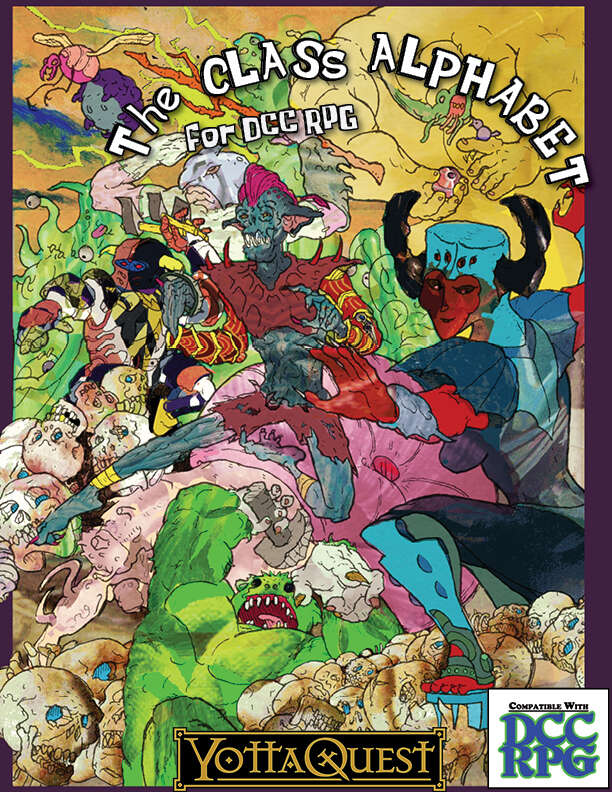
The Class Alphabet for DCC RPG

The Class Alphabet for DCC RPG was written by James V. West, Stephen Murrish, Anne Hunter, Victor Garrison, Jarrett Crader, David Baity, Julian Bernick, R.S. Tilton, Wayne Snyder, Claytonian, Diogo Nogueira, Noah Stevens, Jose Seldana, David Coppoletti, Jeff Goad, Jon Wilson, Reid San Filippo, Justin Isaac, Forrest Aguirre, Terra Fox, Anna Costa, and Rick Kammer. Art is by Danny Prescott, James V. West, Davey Parrott, Jane Elisabeth Thomas, David Coppoletti, Evlyn Moreau, Jon Wilson, R.S. Tilton, Claytonian, Diogo Nogueria, KJ O'Brien, David Lewis Johnson, Ray Otus, Karl Stjernberg, Anna Costa, and Rick Kammer. The publisher is Dungeon Remixer.

Disclaimer: I was given a free pdf from the publisher, in hopes that I would write about this product (which I would have anyway). As a result I noticed a few small edits prior to publication, which resulted in my being given a credit as an editor. My blog, Raven Crowking's Nest, is listed in Appendix III of this work.

This book, not surprisingly, contains an Introduction and a "How to use this book" section. Each is a single page long. Not all of the classes herein are going to fit well into every campaign. With 26 classes to choose from, the odds are that something will fit into any given milieu. None of these classes, however, is simply a Ranger or Paladin variant. Well, there is the Zealot....

For some reason, the publisher decided to make the pdf not only automatically default to a two-page spread, but treated those spreads as single pages. This is not ideal. Obviously, the two-page spread looks good - most pages are designed to take advantage of how one would see the pages in print - but it does make reading the pdf harder than it needs to be. At the point of this writing, a print version is not available.

Let's take closer a look at each of these classes, shall we?

A is for APE ASCENDANT: You are an ape. You are a very smart ape. You are a smart ape with primal strength and rage. You are a very smart ape with primal strength and rage that can deliver powerful psionic blasts. If you wanted to play an analogue of Gorilla Grodd, this is your chance. This is a relatively simple class to understand, taking only a single page of the book.

This class would fit into any tropical milieu with a bit of gonzo, but the PC might have a harder time visiting a tavern. This could also stand in for a yeti-type character, or a subset of Ith’n Ya’roo.

B is for BLACK CAT: Literally a magical black cat, this is nonetheless a fairly complex class which takes a full 12 pages to describe fully. The Black Cat gains spells, its own unique critical hit table, and a full patron write-up for Shammat, Lady of Cats. 

Most campaign milieus will include cats, and most societies are not at all surprised to see cats hanging around where people are. This class could gain wide usage as a result. Shammat might be an interesting patron for wizards and elves.

C is for CYBER-ZOMBIE: This class represents a dead body reanimated and upgraded with technology. Characters have to die in order to become Cyber Zombies, and not every dead character can be revived as such.

This is a complex character class that requires 7 pages to describe, including upgrades that the character might gain. In a milieu similar to Umerica or Mutant Crawl Classics, this class could fit right in. The class might be the result of PC action, or the result of technological processes beyond the characters' control - in this way, an adventure location could create Cyber Zombies as unique PCs even in a nominally medieval setting.

D is for DRUG USER: I am still amazed that Joseph Goodman let this one into the book.

A complex class taking 10 pages to describe, "You sacrifice your sanity to forces from beyond the cosmic veil in exchange for powers unknown in your birth universe. You walk a tightrope between controlling your environment and controlling yourself. If you let your guard down for just one unwary moment, or pursue an ecstatic experience just a little too far, you risk being invaded and ultimately consumed by Transdimensional Cognitive Parasites who skitter around the periphery of your reality, looking for a portal into a host consciousness in your dimension".

Ostensibly, this class could fit into almost any game setting, but including it will definitely change the tone of a campaign. Sadly, there is no mention of taduki.

E is for EDITOR: Taking up two pages, this class is designed with meta-gaming in mind. Serious meta-gaming. As in looking at the judge's notes and reporting back to the party meta-gaming. This might be fun in a one-shot, but I would have a hard time using it in an extended campaign. What else should one expect from "Jarrett Crader & accomplices"?

F is for FLESH-FORGED: This is a two-page re-imagining of Frankenstein's Monster, with an awareness that all of its parts might not actually be human. The class is relatively straight-forward and could fit into almost any milieu. With a little bit of disguise work, it might even be welcome in a tavern. I would limit the use of the class to prevent it from losing its impact.

G is for GOBLIN GANG: Another two-page class, you are literally a gang of small, imp- or gremlin-like goblins. Effectively, this is role-playing a swarm. Does it work? Well, the class is not difficult to understand, but it would have a hard time interacting with the mundane folk of your average village.

It would be easy to reskin this class to fit into almost any campaign milieu, although if the game is strongly human-centric it will not fit. They could be some form of collective intelligence in Star Crawl, Crawljammer, or Phantasmagoria. In Umerica or Mutant Crawl Classics, they would fit right in. In a game based around the Shudder Mountains, Dark Trails Weird Frontiers, or Transylvanian Adventures this class could represent an opponent, but probably will not be a comrade-in-arms.

H is for HELLFONT: Why allow wizards to have all the fun of demonic patrons and corruption? Now your Warrior-type character can have them too! Although not a complicated class, it does take 4 pages to also document the powers and corruptions you might have. I picture this class as being inspired by Venger from the old Dungeons & Dragons cartoon, but I could certainly be wrong.

If there are demonic patrons in your milieu, this class will fit. You might have trouble mingling with other folk, however,

I is for INTELLIGENT WEAPON: Here is an interesting idea: your PC is an intelligent weapon. This also means that you need a thrall...some feckless would-be adventurer that you can control and act through. It is a neat idea, taking three pages to detail, and is not overly complicated. Although a magical sword, axe, or hammer might be the go-to ideas that come to the average player, it would be easy to use this class in Mutant Crawl Classics, Star Crawl, or Umerica with a more technological base. Not every magical ability is easily converted to a technological ability, but transition should go smoothly with a little judicious interpretation.

J is for JOCKEY: This is a one-page class for those who might wish to ride some form of critter. It isn't complicated and, for the most part, it should translate easily to almost any game milieu. If  the idea of a PC mounted on an umber hulk is too gonzo for you, use sparingly!

K is for KNAVE: This is possibly the most complex class created for Dungeon Crawl Classics at the time of this writing. It is not surprising, then, that it takes a full 30 pages to fully describe. 

"Knaves are selfish in the extreme. They take what they want, and live off other people’s labor. Knaves take the largest slice of pie; they drink the whole pail of water. Knaves want the biggest and the best, the first pick, the choicest cut. They demand service and servitude, and anyone who stands against them gets beaten down full sore. Knaves blackmail and ambush, they burgle and break, they wheedle, they scheme, and they’ll fight to the death – but never lift a finger to do an honest day’s work."

What sets them apart, though, is service to the Arcana. The Knave has a mystical relationship to the tarot deck, They have a suit chosen from those of standard playing cards - Clubs, Spades, Diamonds, and Hearts - that helps to define their powers. In short, once more, they are complicated. Flavorful, but complicated. You will want to have this section printed out at the table if you play a Knave or have one in your game. 

Depending upon how your magic is styled, this class may or may not fit into your milieu. It would be perfect in a game inspired by Faerie Tales from Unlit Shores, but might seem out of place on the Purple Planet. Or not. It's your game.

L is for LEMURIAN: Another ape-themed class, this one being a man-ape with ancient memories but no overt psionics. Well, the picture shows a man-ape, but this could just as easily describe Brule the Spear-Slayer from Robert E. Howard's Kull stories, or some of the heroes of Lin Carter's more tongue-in-cheek Lemurian Cycle. The class is not complicated, clocking in at three pages. If your milieu includes ancient peoples in a primordial world, the Lemurians may do nicely.

M is for MONSTER TRAINER: Clearly inspired by Pokémon, this somewhat complicated class only takes three pages to describe. Unfortunately, the sample monsters from the Working Class Alphabet are not reproduced (so you had better get that as well...) but, then, anyone travelling in a DCC milieu is bound to encounter something worth catching.

Because of the obvious source of inspiration, this class might not fit into all milieus. However, the writing is good, and the class could fit into almost any game. 

N is for NINJA VAMPIRE: You are a ninja. You are a vampire. It takes two pages to describe what this means, because, after all, "Ninja Vampire" is not a hard concept to grasp. Whether or not your character fits into a particular campaign milieu is another matter. This class is particularly appropriate appearing in the ruins of Seattle in an Umerican campaign.

O is for OGRE: You are an ogre. It isn't that complicated. Your class takes three pages to describe because you get your own special crit table. You get that table because you are big and you like to bite things. There are probably a lot of campaign milieus where you can't get seated in a tavern.

P is for PUPPET MASTER: This class casts spells and controls puppets, which makes it rather like the villain of A. Merritt's Burn, Witch, Burn! This is not very complicated, but takes 3 pages to describe because the puppets themselves must be described. This class could fit into most settings.

Q is for QUANTUM WANDERER: "You are misplaced in time and space — lost, marooned, or simply not where you started — but in any case, you come from a world very different to the primitive one you find yourself on now. Though it must be said these primitives do keep finding ways to surprise you with their inventiveness. You may be moving on as soon as your etheric beam emitter is working again and your towel is dry, or perhaps this is where you’ve decided to settle long term. Or you may be searching this world high and low, in hopes of finding a way back to where you belong..."

This class takes three pages to describe and assumes that the PC comes from an advanced future. Appendix N fiction is filled with modern people become embroiled in other worlds, be they the past of their own world, or other worlds such as Mars or Venus. Here we are more into Kang the Conqueror or Booster Gold territory.

R is for RO-BARD: This is a robot entertainer. Although the class uses standard DCC class metrics, this is clearly a class that would fit well into the Umerican setting. It might also fit well in Star Crawl, Phantasmagoria, or Crawljammer. Not overly complicated, the class takes 3 pages to describe.

S is for SLIMENOID: A simple, single-page class that is also not likely to be welcome in the average tavern. "Mucal invader, is there no end to your oozing?!" Strangely, though, I could see this class working in most campaign milieus. In some, the Slimenoid would be an anomaly, but in a Mutant Crawl Classics game? Slime on!

T is for TENACIOUS D-FENDER: This is a three-page class dedicated to Tenacious D - effectively a parody of a parody. Nonetheless, it is a playable class...although playing one will very likely affect the tone of the game.

U is for UBIQUARIAN: "Everyone has wished they could be in two places at once, but the ubiquarian actually can—and some can even be in up to sixteen places at once!" It's an interesting idea for a class, and one that could fit into a great many campaign milieus. The class is not overly complex, and takes up three pages including a table for Astral Mishaps. Probably more importantly, the rules allow the class to do some unique things - including providing advanced scouting - but it should not overwhelm the table.

V is for VELOCIRAPTOR: A two-page description of a Velociraptor class. For other takes on similar classes see The Goodman Games 2017 Gen Con Program Book, Crawling Under a Broken Moon #14, Hubris, and Tales of the Fallen Empire. DCC players seem to have a thing for playing saurians. They are even part of Primal Tales.

W is for WOLF GIRL: "Bristling with primal energy, finely tuned to her territory, thriving on self-governance—the Wolf Girl is an unapologetic autarch, motivated by razor sharp instincts and a ferocious drive to survive. Her prevailing ideology is essentially solipsistic: preservation of self, and of the environs that sustain her. Threats to this paradigm are dispatched with swift brutality. Depending on her natural empathy, a Wolf Girl’s sense of self can expand to include friends and causes, which she will defend with exceptional displays of courage and sacrifice.

Wolf Girl has an inner wolf; she is a shifter, dominated by mood swings, focused anger, and unresolved trauma. Residing in the wild, she and her lupine companion are self-possessed, meditative, and stunningly savage. 

A Wolf Girl might use her connection with the earth to craft potent medicines, bezoars, and alchemical components. She might also be a master of her physical reality: platforming buildings, deflecting gunfire, and lancing targets from hundreds of yards away. Wolf Girl’s origins and motivations differ as well. The Wolf Girl is a paragon of natural balance."

This is a magical female Mowgli which takes two pages to describe. The Wolf Girl would fit into most campaign milieus, but would excel at outdoor adventuring away from the confines of both the city and the dungeon.  

X is for XENOCYTE: A two-page class that seems a bit Alien. There are game milieus into which this would fit (Star Crawl springs to mind), but I have a hard time imagining Xenocytes mingling in the tavern after an adventure, or carousing on the streets of Lankhmar.

Y is for YOUTHFUL MUSICIAN: "In every age, in every land, there have been those good souls who travel amongst the needy and who work to undo the machinations of evil. There is something about youth, exuberance, and transgressive music that stirs adolescence and young adults into travel and the championing of all that is good and right. Often, these foolhardy souls simply strive to right the wrongs caused by petty men and women against their neighbors, but every now and then they stymie the efforts of galaxy-spanning cults, supernatural beings, and weird entities from beyond the stars. They fight the good fight for the sheer reward of it, asking no recompense and wandering here and there living where the needs of Law might take them. They tend to attract weirdness of all kinds, and are frequently accompanied by talking animals, beneficent spirits, barmy obsolete robots, and all manner of other companions. Playing music is something of a side gig, or perhaps solving mysteries is the side gig - often there is no way to tell..."

This two-page class is inspired by Jeff Quick’s game Hijinx, appearing in Polyhedron #158. It is a joke class, like the Hot Dog Suit, which will definitely alter the tone of whatever game it appears in.

Z is for ZEALOT: The last class in the book is a two-page divine champion which is definitely promoting a single god. This should fit easily into most campaigns.

Appendices: The book also includes three appendixes. The first deals with esoteric rules and frequently asked questions. The second breaks down the classes into the in-game roles they fill. A discerning judge might reproduce the list from this chart to indicate which options are available in their game. An even more discerning judge might allow certain classes to become available as rewards for meeting certain Quest For It goals, or for playing through specific adventures. Finally, there is an appendix of resources, including an Alphabet of Game Worlds.

The Class Alphabet for DCC RPG introduces 26 NEW classes to your game. Each is fully playable from level 1 to 10, and there's a class for every letter of the alphabet! Within this book you will find a mythic proportion of options for any variety of game setting or playstyle. Every class has been lovingly handcrafted and lavishly illustrated by a team of gongfarming gamers from every corner of the globe. These classes will not only elevate your game to new heights of gonzo-infused frenzy, but will also inspire a multitude of ideas to help judges and players develop their own unique content.

Apes, robotic bards, quantum vagrants, shadow manipulators, monster trainers, puppet masters, ogres, dinosaurs, hellbound warriors, tenacious d-fenders, and gangs of goblins are JUST A FEW of the madcap character classes you'll discover inside. All completely illustrated with accompanying spells, crit tables, powers, and other bizarre tables of options.

Strap in, because your game is about to experience a paradigm shift and things may never again be the same!

Get It Here!