Showing posts sorted by relevance for query umerica. Sort by date Show all posts

Friday, 27 August 2021

The Twisted Menagerie Manual

The Twisted Menagerie Manual is a collection of creatures for the Umerica campaign setting. It was written by Reid San Filippo and Bob Brinkman, with additional content by Daniel J. Bishop, Gilbert Isla, and Tanner Yea. Illustration is by Nate Marcel (including cover), Aaron Robinson, Andrew Walter, Brad Morris, Clip art, David Coppoletti, Diogo Nogueira, Frank Turfler Jr., James V West, Karl Stjernberg, KJ O'Brien, Lee Anthony “Deadpoolrus” DeviantArt (CC BY SA3), Matt Hildebrand, Matt Jordan, and Richard Tingley. The publisher is Shield of Faith Studios, LLC.

Disclaimer: I have an "Additional Content" credit on this for use of the Doomriders from this blog post. This was an unpaid contribution.

What we have here is a hefty collection of creatures, not all of which are "combat-only" types. All of them are at home in the post-Apocalyptical setting of Umerica. Many would be at home in other settings as well, including Mutant Crawl Classics, Hubris, and more vanilla Dungeon Crawl Classics games. Definitely, many of these beings would fit into a Star Crawl or Galaxy Black milieu.

The Umerica setting, from The Umerican Survival Guide onward, does use different rules for armor than the core DCC rules. This book provides everything you need to convert monsters from the Umerica rules to standard rules and vice versa. 

It also contains a section on Boss Monsters, that gives the reader/judge some idea of how to utilize these beings to create the "Big Bad" for an adventure or campaign arc. Overall, it is an extremely impressive piece of work. 

The Twisted Menagerie Manual is brought tangentially as part of a wider Umerica discussion on the Order of the Shanna podcast here. Umerica is discussed on the Glowburn podcast here.

The wild and weird world of Umerica is a dangerous place filled with murderous creatures. It’s a good thing too since XP does not grow on trees! Within these pages dwell a cornucopia of crafty creatures to cram your campaign with consternation and paralyze your party with panic. Each one listed with adventure hooks to help drop them into your game.

Take a look at this selection of monster names from this tome

Apocalypse Ooze • Autogiest • Autovore • Beetle Apes • Blast Shades • Bowel Tyrant 
Can Crabs • Cake Horror • Clown Servants of Buddy O’Burger • Constrictor, Mutant
Corpsenado • Cryo-lurker • Cyber Ghoul • Cyber Saucer Simian • Demolishroom
Dinosaurs • Dinosaurs, Augmented • Dinosaurs, Mutant • Shroomers • Ox Beetles • Pigtipede
The Discarded • Doomrider • Dragon, Biohazard • Dragon, Cryo • Dragon, Forest
Dragon, Gearhead • Holographic Dragon • Robot Dragon • Xeno Dragon • eGhost
Elementals-Data • Elementals-Debris • Elementals-Gun • Falcon Wolf • Flying Laser Ursine
Frab • Fruiti-Slush Ooze • Game Devil • Golem, Junk • Golem, Mannequin • Golem, Plush
Golem, Vehicle • Greenman Swarm • Hippotaur • Iguanadillo • Insect, Mutant
Jack-O-rang-utan • Komo-doans • Linoleumoeba • Lion-Snake • Luck Eater • Menfish
Monitor Lizards • Muckraker • Mutitan • Newt, Aberration • Octowolf • Orbus • Power Wight
Puppetcubi • Quantum Ape • Railipede • Rail Wraith • Reindire • Rerun Wraiths • RoboDevil
Robo-Lich • Robots • Rocker • Rockin’ Wraith • Scorpionoid • Septicraken • Serpent Shrubs
Sharkhana • Shriek • Splice Fiend • Sporefangs • Techno-Mimic • Think Tank • Toycubim
Trapdoor Toadspider • Trashlodyte • Tru-Pet • Un Men • V.E.T.T. • Varrok • Vendibeast
Whalephant • Wraith Rider • Whaaar Mutts • Wheeler Demon • Wrath • Xeno-Locusts
Xenotaur • Xeno Mummy • Yowling Atrocity • Zilla • Blink Zombies • Chrono Zombies
Melting Zombies • Petrol Zombies • Rave Zombies • Silver Zombies
Zombie Monks of the Cyberhive

Besides over 100 brutal beasts, this book also contains a bevy of barbarous Bosses based on a few of the creatures within. Each one listed with a backstory, common followers, motivations, and more.

The icing on the irradiated cake is the Scenario Sketches, a bunch of rough encounter ideas incorporating one or more of the monsters from this tome, all ready to be polished a bit and dropped into your campaign on short notice.

Get It Here!

Friday, 2 September 2016

Crawling Under a Broken Moon #6

Crawling Under a Broken Moon #6 is written by Reid San Filippo, Chris Tamm, R. Dale Bailey Jr, and Sean Ellis. It is published by Shield of Faith Studios.

This is actually one of my favorite issues of the zine, which brings the full Mad Max experience to Umerica...but still being very much Dungeon Crawl Classics. So let's jump right in and see what we have.

The Petrol Head 

"The wastelands are teeming with life and it all wants to rob, kill , and eat you, hopefully in that order. If you want to survive you need a good set of wheels, the ability to find what you need, and the will to do what it takes to stay alive."

Can your average Umerican PC drive a car? Ask your judge. If you absolutely must drive some sort of vehicle, though, this class is for you. This is a strong class, which uses mechanics reskinned from the Thief, Warrior, and Dwarf to create a specific set of skills. You also start with a vehicle...not a great vehicle, but a vehicle nonetheless.

Mayhem Behind the Wheel

Do you remember Car Wars? This was Steve Jackson Games' paean to the furious action of the original Mad Max movies and similar fare (like the Spy Hunter arcade game!). It was a bit fiddly, being more of a war game than a role-playing game, but it was fun. Here, you are given rules to drive around and kill things Umerica-style, with a little less fiddling and a lot more role-playing.

Rules are given for wipeouts, chases, ramming, and all the other goodness one would expect. "Popping the Hood" is a form of "Recovering the Body" for vehicles. Fuel consumption is abstracted in a way that works.

Suddenly, the mending spell is really, really worthwhile!

What’s Under the Hood?

In the post-Apocalyptic wastes of Umerica, not every vehicle is going to be the same. Therefore, rules are presented for creating new ones, by building off the basic statblocks of more familiar types of transportation. Vehicle quality levels and traits can make each vehicle different from others with a similar build. Most of the usable vehicles you encounter will surely be Beaters, but finding a rare Custom vehicle is like finding a magical artifact!

Of note is the "Possessed" trait, allowing a car to be "powered by an entrapped elemental or minor demon." Yes, you really can have a car that runs on blood or candy in Umerica. Or you might just decide to stat up Stephen King's Christine.

The Random Road Gang Generator

What it says on the tin: a quick and easy way to generate a random (but interesting!) road gang to menace your adventurers! After all, what is Mad Max without a Toecutter, a Humongous, or an Immortan Joe? What are those villains without a gang to back them up?

In the event that a gang of un-dead nuns (religious garb) driving armored delivery trucks, usiing flamethrowers (holy fire?) while out to recruit new followers isn't enough for you, the issue provides a link to another random road gang generator by Roy Snyder.

d100 Stuff Found on Apocalyptic Roadways

If you are not familiar with Elfmaids & Octopi, you should be - it's a blog with a lot of inspirational content. This list of random encounters and stuff is originally by Chris Tamm, and DCC’ified by Reid San Filippo. It is used by permission. Some of these ideas are color. Others you could design entire adventures around.

Twisted Menagerie

R. Dale Bailey Jr brings you the Petrol Zombie, un-dead that store gasoline in their guts. That's right - you don't want to firebomb them, and you do want to recover the fuel. Have fun with that. You might end up with petrol sickness if you aren't careful.

This sort of monster is not only perfect for the issue's theme, but it is also a strong recurrent monster. They are found in zombie herds, but it is pretty easy to imagine them hanging out near old gas stations, where you are going to need to go. They make your life more dangerous, but they aso have something you want. If you are willing to undergo a bit more risk, you can gain a larger benefit.

Overall, you just have to keep making choices, and that's what the game is all about.

Saturday, 3 September 2016

Crawling Under a Broken Moon #11

Crawling Under a Broken Moon #11 is written by Reid San Filippo, David VC, and Tim Bruns. It is published by Shield of Faith Studios. This is a jam-packed issue, with lots of cool stuff to play with, so we'll jump right in.

Worship, Umerica style 

Tim Bruns and Reid San Filippo offer a "treatise on the faiths of Umerica and their clergy", including new rules for clerics that worship the various beings described. There is plenty of room for other deities in the wastelands...after all the God of the Pit from Issue #7 is not represented! Still, you get a lot in a small amount of space with this article.

Classica: "The goddess of Rhythm and Order, she binds all things together through music, rhythm, and focus."

Santa: "[T]he jolly avatar of giving, hope and joy".

S’aganoid: An entity whose "worshipers seek both knowledge, and the truth behind it." This is all types of knowledge, so they are sometimes very welcome, and sometimes shunned.

The Lords of Light: The entities to whom Aetherian heroes and honorable barbarians call out to, the Lords of Light "appreciate reckless, selfless actions for the benefit of a lawful cause." Anyone familiar with Thundarr the Barbarian is familiar with their name.

$ (Cash): "The impartial goddess of barter and wealth, her priests are often called upon to mediate in trade negotiations and disputes."

Grokk: The god of the twisted Wilds and the Wastes described under the Jack-O-rang-utan entry in Issue #10. His followers are, effectively, the druids of Umerica, who "seek to be one with nature and the universe, and view those who threaten their peace and serenity as dangerous radicals who must be stopped or destroyed."

Kizz: First mentioned in The Mall Maul in Issue #3, and then more fully described in Issue #4. "Kizz takes center stage as a god who both unites and divides the other gods. Some stories have Kizz and Classica fathering Technos Discos, but many of the god’s parentage is to be called into question when Kizz is involved. Kizz’s worshipers live life loudly and awesomely in their search to attain “Enlightened Awesomeness”."

Petrolex: "Fuel is love, fuel is life, fuel is freedom."

Nuka: "The Mother of Mutants" would just like to see a healthy glow on her followers' cheeks. Or radiating out from them. Or something like that.

Theszolokomodra: First encountered in The Mall Maul in Issue #3, and more fully described in Issue #4, "Theszolokomodra is usually a neutral god, but he has so many heads that many can manifest as lawful or chaotic, thus his worshipers can be of any alignment. Followers are entrusted to seek out knowledge and experience."

Elmos: "The Evil Puppet Master and corrupter of children, Elmo’s is a master manipulator, hiding evil intent behind a pleasant smile and a friendly demeanor". A masterpiece.

Silk: The Golden Lord of Lies.

Technos Discos: The chaos god of music was first mentioned in The Mall Maul in Issue #3. "His followers tend to be young, wandering souls who bring beats to places where there were none. Preferably to places where prohibited."

Yyaallaayy: "The outer dimensional lord of madness and creature of chaos. Few understand if only the mad seek to worship Yyaallaayy, or if those that seek to worship him go mad." Perhaps names from a battle cry in Thundarr the Barbarian?

Racial Recast 

You would think that bringing a whole new pantheon to light would be enough for a single issue, but you would be wrong. Author David VC brings an alternate take on the post-apocalyptic Halfling class as the "Feral Urchin". And it is good.

Depending upon alignment, a Feral Urchin may be a Wildchild (usually Chaotic), a Slinger (usually Neutral) or a Nerd (usually Lawful). Wildchildren invoke their Patron (Zendakk) to enter the Wild Rumpus, where they transform into small Beasts "with an assortment of features from various predators. The Beast’s fur/feathers/scales are often garishly hued." This is pure, and brilliant, Where the Wild Things Are. Slingers "are deadly shots" with any thrown or hurled weapon - think the feral boy in The Road Warrior. Finally, Nerds "are beloved of their Patron, a sentient algorithm named (Ur) K3L." Nerds are very good at repairing old tech or using computers.

But, of course, you cannot have feral children who refuse to grow up without invoking Peter Pan, and the Feral Urchin does so as well. This is about as close to perfect as one can get.

Weapons of the Wastelands

And yet there is still more! This article on post-Apocalyptic armor and new gear includes armor made from tires or scrap, protective sports gear, force field belts. Weapons include the necessary chainsaw and compound bow as well as the grill tank bomb and saw blade slinger.

There is a subsection on cheap (damaged) goods and quick fixes. This bit may be usable for Dungeon Crawl Classics of any flavor.

The Hologram 

Okay, that has to be all this issue can hold, right? Wrong.

Next, David VC introduces a Hologram AI class that is part Star Trek: Voyager and part Tron, while fitting wholly into the Umerican landscape of Crawling Under a Broken Moon. As with the Feral Urchin, this is an excellent class.

Twisted Menagerie 

The Scorpionoid is a centaur-like scorpion creature that is easily addicted to caffeinated soda pop, and are willing to fight as mercenaries. Preferred payments are fresh blood, raw sugar, or honey. Or perhaps that last can of Coke.

By the Way

A quick table to use when a deity calls in a favor from a PC's cleric. This is most definitely usable at any Dungeon Crawl Classics game table that hasn't done away with clerics altogether.

Sunday, 14 August 2016

Crawling Under a Broken Moon #1

Crawling Under a Broken Moon #1, is by Reid “Reidzilla” San Filippo and is published by Shield of Faith Studios. I am not 100% certain off the top of my head, but I believe that this was the first "setting zine" for Dungeon Crawl Classics, to be followed by Crawljammer, Metal Gods of Ur-Had, and Black Powder, Black Magic. I imagine that if I am wrong, someone will correct me in the comments.

Crawling Under a Broken Moon does not begin with a 0-level primer. It jumps right into the action. This could be a problem for some judges, but there is no reason to not simply use this material with Dungeon Crawl Classics as it stands.

I would like to also point out that this issue is really a work of love coming from a single source. Apart from editing by Jason Bossert, Reid did it all - cover art, interior art, and writing. That understated cover carries all of the energy and enthusiasm of the early Judges' Guild materials, and is a good example of how individuals can open up whole new vistas with Dungeon Crawl Classics. And then share those vistas with the rest of us!

This issue contains:

Welcome to Umerica

Running adventures in a "Gonzo Post-Apocalyptic Fantasy World" takes a slight bit of adjustment. Table DDD: Found Item Condition Table is of particular use. This might even be something that a cunning judge could borrow for other Dungeon Crawl Classics settings....even the most standard settings might have a windmill or a windlass that has seen better days.

The main setting for Crawling Under a Broken Moon is Umerica, a post-Apocalyptic version of the United States which allows for a wide range of adventures. Clearly, inspirations included cartoons like Thundarr the Barbarian, as well as earlier games such as the original Gamma World. It would be pretty easy to place adventures in the ruins of any continent or nation if you so choose.

The Technologist

Described as a "class dedicated to the accumulation of scientific knowledge and power", this is more like a class dedicated to the understanding and use of ancient technologies. It's a good class, but it requires that the judge seed appropriate technologies in his adventures. That shouldn't be a problem when Crawling Under a Broken Moon.

Weapons of the Wastelands

Obviously, guns are going to be considered important to the survivors of this twisted landscape, and Reid San Filippo provides an excellent set of rules summarized from articles by Reverend Dak and Mike Evans in Crawl! fanzine #8, used with permission.

Twisted Menagerie

This first issue offers four creatures appropriate for adventures in Umerica.

The Sharkhana are the descendants of shock troopers bred by aliens from sharks. They might trade if they are not hungry. They are usually hungry.

Debris elementals are exactly what they sound like - elemental creatures created from the debris that litters the Umerican ruins. Although it does not appear in the description, I like the idea of a debris elemental that contains a vital bit of technology in its swirling mass of junk. The PCs would need to extract the goods, even if they failed to kill the monster.

The sentrybot is a souped-up version of the security robots that are already being tested out in real life. They follow a strict program, and do not kill. Unless they are programmed to kill. Then all bets are off.

The lobstrosity is an alien crustacean that seems to mix inspiration from Stephen King's Dark Tower series, H.P. Lovecraft's Mig-Go, and the garbugs of the 1st Edition Advanced Dungeons & Dragons Fiend Folio.

An Interesting Place to Die

The issue is rounded off with a description of Blooms Fashions, "a store with clothes to die for". If you are a fan of Doctor Who or Kolchak the Night Stalker, you should be able to add some fun details to this area, or expand it into an entire adventure!

Foretold in the ancient calendars, early in the 21st century a rogue object from deep space hurtled between the Earth and the Moon. Its passage caused catastrophic destruction around the globe, ripping the very fabric of time and space itself; yet mankind still survived. Centuries later, the planet is reborn… a strange new place of alien wonder and death: a world ruled by savagery, cruel sorcery, and twisted science. Now is the time for the mighty to rise up and take their place in this perilous and untamed land. Will they bring justice or suffering? Only time will tell...

Sunday, 27 December 2020

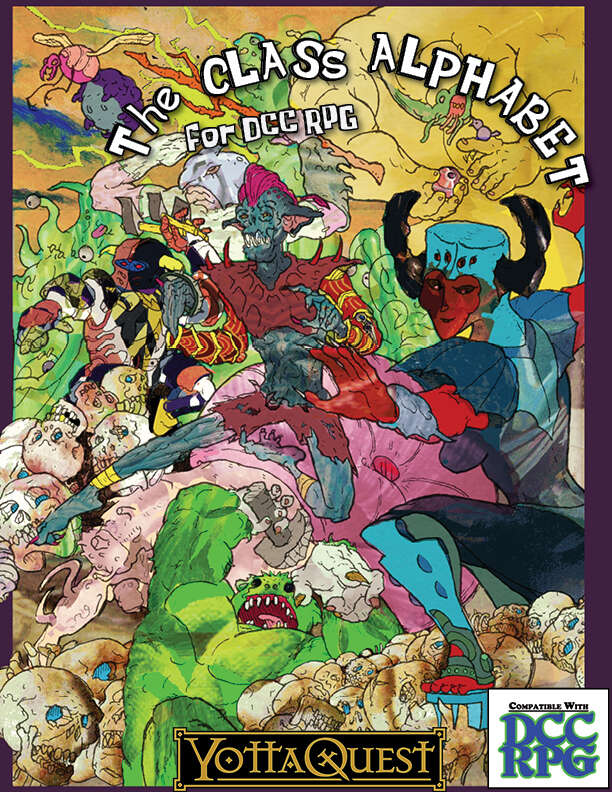
The Class Alphabet for DCC RPG

The Class Alphabet for DCC RPG was written by James V. West, Stephen Murrish, Anne Hunter, Victor Garrison, Jarrett Crader, David Baity, Julian Bernick, R.S. Tilton, Wayne Snyder, Claytonian, Diogo Nogueira, Noah Stevens, Jose SeldanaDavid Coppoletti, Jeff Goad, Jon Wilson, Reid San Filippo, Justin IsaacForrest Aguirre, Terra Fox, Anna Costa, and Rick Kammer. Art is by Danny Prescott, James V. West, Davey Parrott, Jane Elisabeth Thomas, David Coppoletti, Evlyn Moreau, Jon Wilson, R.S. Tilton, Claytonian, Diogo Nogueria, KJ O'Brien, David Lewis Johnson, Ray Otus, Karl Stjernberg, Anna Costa, and Rick Kammer. The publisher is Dungeon Remixer.

Disclaimer: I was given a free pdf from the publisher, in hopes that I would write about this product (which I would have anyway). As a result I noticed a few small edits prior to publication, which resulted in my being given a credit as an editor. My blog, Raven Crowking's Nest, is listed in Appendix III of this work.

This book, not surprisingly, contains an Introduction and a "How to use this book" section. Each is a single page long. Not all of the classes herein are going to fit well into every campaign. With 26 classes to choose from, the odds are that something will fit into any given milieu. None of these classes, however, is simply a Ranger or Paladin variant. Well, there is the Zealot....

For some reason, the publisher decided to make the pdf not only automatically default to a two-page spread, but treated those spreads as single pages. This is not ideal. Obviously, the two-page spread looks good - most pages are designed to take advantage of how one would see the pages in print - but it does make reading the pdf harder than it needs to be. At the point of this writing, a print version is not available.

Let's take closer a look at each of these classes, shall we?

A is for APE ASCENDANT: You are an ape. You are a very smart ape. You are a smart ape with primal strength and rage. You are a very smart ape with primal strength and rage that can deliver powerful psionic blasts. If you wanted to play an analogue of Gorilla Grodd, this is your chance. This is a relatively simple class to understand, taking only a single page of the book.

This class would fit into any tropical milieu with a bit of gonzo, but the PC might have a harder time visiting a tavern. This could also stand in for a yeti-type character, or a subset of Ith’n Ya’roo.

B is for BLACK CAT: Literally a magical black cat, this is nonetheless a fairly complex class which takes a full 12 pages to describe fully. The Black Cat gains spells, its own unique critical hit table, and a full patron write-up for Shammat, Lady of Cats. 

Most campaign milieus will include cats, and most societies are not at all surprised to see cats hanging around where people are. This class could gain wide usage as a result. Shammat might be an interesting patron for wizards and elves.

C is for CYBER-ZOMBIE: This class represents a dead body reanimated and upgraded with technology. Characters have to die in order to become Cyber Zombies, and not every dead character can be revived as such.

This is a complex character class that requires 7 pages to describe, including upgrades that the character might gain. In a milieu similar to Umerica or Mutant Crawl Classics, this class could fit right in. The class might be the result of PC action, or the result of technological processes beyond the characters' control - in this way, an adventure location could create Cyber Zombies as unique PCs even in a nominally medieval setting.

D is for DRUG USER: I am still amazed that Joseph Goodman let this one into the book.

A complex class taking 10 pages to describe, "You sacrifice your sanity to forces from beyond the cosmic veil in exchange for powers unknown in your birth universe. You walk a tightrope between controlling your environment and controlling yourself. If you let your guard down for just one unwary moment, or pursue an ecstatic experience just a little too far, you risk being invaded and ultimately consumed by Transdimensional Cognitive Parasites who skitter around the periphery of your reality, looking for a portal into a host consciousness in your dimension".

Ostensibly, this class could fit into almost any game setting, but including it will definitely change the tone of a campaign. Sadly, there is no mention of taduki.

E is for EDITOR: Taking up two pages, this class is designed with meta-gaming in mind. Serious meta-gaming. As in looking at the judge's notes and reporting back to the party meta-gaming. This might be fun in a one-shot, but I would have a hard time using it in an extended campaign. What else should one expect from "Jarrett Crader & accomplices"?

F is for FLESH-FORGED: This is a two-page re-imagining of Frankenstein's Monster, with an awareness that all of its parts might not actually be human. The class is relatively straight-forward and could fit into almost any milieu. With a little bit of disguise work, it might even be welcome in a tavern. I would limit the use of the class to prevent it from losing its impact.

G is for GOBLIN GANG: Another two-page class, you are literally a gang of small, imp- or gremlin-like goblins. Effectively, this is role-playing a swarm. Does it work? Well, the class is not difficult to understand, but it would have a hard time interacting with the mundane folk of your average village.

It would be easy to reskin this class to fit into almost any campaign milieu, although if the game is strongly human-centric it will not fit. They could be some form of collective intelligence in Star Crawl, Crawljammer, or Phantasmagoria. In Umerica or Mutant Crawl Classics, they would fit right in. In a game based around the Shudder MountainsDark Trails Weird Frontiers, or Transylvanian Adventures this class could represent an opponent, but probably will not be a comrade-in-arms.

H is for HELLFONT: Why allow wizards to have all the fun of demonic patrons and corruption? Now your Warrior-type character can have them too! Although not a complicated class, it does take 4 pages to also document the powers and corruptions you might have. I picture this class as being inspired by Venger from the old Dungeons & Dragons cartoon, but I could certainly be wrong.

If there are demonic patrons in your milieu, this class will fit. You might have trouble mingling with other folk, however,

I is for INTELLIGENT WEAPON: Here is an interesting idea: your PC is an intelligent weapon. This also means that you need a thrall...some feckless would-be adventurer that you can control and act through. It is a neat idea, taking three pages to detail, and is not overly complicated. Although a magical sword, axe, or hammer might be the go-to ideas that come to the average player, it would be easy to use this class in Mutant Crawl Classics, Star Crawl, or Umerica with a more technological base. Not every magical ability is easily converted to a technological ability, but transition should go smoothly with a little judicious interpretation.

J is for JOCKEY: This is a one-page class for those who might wish to ride some form of critter. It isn't complicated and, for the most part, it should translate easily to almost any game milieu. If  the idea of a PC mounted on an umber hulk is too gonzo for you, use sparingly!

K is for KNAVE: This is possibly the most complex class created for Dungeon Crawl Classics at the time of this writing. It is not surprising, then, that it takes a full 30 pages to fully describe. 

"Knaves are selfish in the extreme. They take what they want, and live off other people’s labor. Knaves take the largest slice of pie; they drink the whole pail of water. Knaves want the biggest and the best, the first pick, the choicest cut. They demand service and servitude, and anyone who stands against them gets beaten down full sore. Knaves blackmail and ambush, they burgle and break, they wheedle, they scheme, and they’ll fight to the death – but never lift a finger to do an honest day’s work."

What sets them apart, though, is service to the Arcana. The Knave has a mystical relationship to the tarot deck, They have a suit chosen from those of standard playing cards - Clubs, Spades, Diamonds, and Hearts - that helps to define their powers. In short, once more, they are complicated. Flavorful, but complicated. You will want to have this section printed out at the table if you play a Knave or have one in your game. 

Depending upon how your magic is styled, this class may or may not fit into your milieu. It would be perfect in a game inspired by Faerie Tales from Unlit Shores, but might seem out of place on the Purple Planet. Or not. It's your game.

L is for LEMURIAN: Another ape-themed class, this one being a man-ape with ancient memories but no overt psionics. Well, the picture shows a man-ape, but this could just as easily describe Brule the Spear-Slayer from Robert E. Howard's Kull stories, or some of the heroes of Lin Carter's more tongue-in-cheek Lemurian Cycle. The class is not complicated, clocking in at three pages. If your milieu includes ancient peoples in a primordial world, the Lemurians may do nicely.

M is for MONSTER TRAINER: Clearly inspired by Pokémon, this somewhat complicated class only takes three pages to describe. Unfortunately, the sample monsters from the Working Class Alphabet are not reproduced (so you had better get that as well...) but, then, anyone travelling in a DCC milieu is bound to encounter something worth catching.

Because of the obvious source of inspiration, this class might not fit into all milieus. However, the writing is good, and the class could fit into almost any game. 

N is for NINJA VAMPIRE: You are a ninja. You are a vampire. It takes two pages to describe what this means, because, after all, "Ninja Vampire" is not a hard concept to grasp. Whether or not your character fits into a particular campaign milieu is another matter. This class is particularly appropriate appearing in the ruins of Seattle in an Umerican campaign.

O is for OGRE: You are an ogre. It isn't that complicated. Your class takes three pages to describe because you get your own special crit table. You get that table because you are big and you like to bite things. There are probably a lot of campaign milieus where you can't get seated in a tavern.

P is for PUPPET MASTER: This class casts spells and controls puppets, which makes it rather like the villain of A. Merritt's Burn, Witch, Burn! This is not very complicated, but takes 3 pages to describe because the puppets themselves must be described. This class could fit into most settings.

Q is for QUANTUM WANDERER: "You are misplaced in time and space — lost, marooned, or simply not where you started — but in any case, you come from a world very different to the primitive one you find yourself on now. Though it must be said these primitives do keep finding ways to surprise you with their inventiveness. You may be moving on as soon as your etheric beam emitter is working again and your towel is dry, or perhaps this is where you’ve decided to settle long term. Or you may be searching this world high and low, in hopes of finding a way back to where you belong..."

This class takes three pages to describe and assumes that the PC comes from an advanced future. Appendix N fiction is filled with modern people become embroiled in other worlds, be they the past of their own world, or other worlds such as Mars or Venus. Here we are more into Kang the Conqueror or Booster Gold territory.

R is for RO-BARD: This is a robot entertainer. Although the class uses standard DCC class metrics, this is clearly a class that would fit well into the Umerican setting. It might also fit well in Star Crawl, Phantasmagoria, or Crawljammer. Not overly complicated, the class takes 3 pages to describe.

S is for SLIMENOID: A simple, single-page class that is also not likely to be welcome in the average tavern. "Mucal invader, is there no end to your oozing?!" Strangely, though, I could see this class working in most campaign milieus. In some, the Slimenoid would be an anomaly, but in a Mutant Crawl Classics game? Slime on!

T is for TENACIOUS D-FENDER: This is a three-page class dedicated to Tenacious D - effectively a parody of a parody. Nonetheless, it is a playable class...although playing one will very likely affect the tone of the game.

U is for UBIQUARIAN: "Everyone has wished they could be in two places at once, but the ubiquarian actually can—and some can even be in up to sixteen places at once!" It's an interesting idea for a class, and one that could fit into a great many campaign milieus. The class is not overly complex, and takes up three pages including a table for Astral Mishaps. Probably more importantly, the rules allow the class to do some unique things - including providing advanced scouting - but it should not overwhelm the table.

V is for VELOCIRAPTOR: A two-page description of a Velociraptor class. For other takes on similar classes see The Goodman Games 2017 Gen Con Program Book, Crawling Under a Broken Moon #14, Hubris, and Tales of the Fallen Empire. DCC players seem to have a thing for playing saurians. They are even part of Primal Tales.

W is for WOLF GIRL: "Bristling with primal energy, finely tuned to her territory, thriving on self-governance—the Wolf Girl is an unapologetic autarch, motivated by razor sharp instincts and a ferocious drive to survive. Her prevailing ideology is essentially solipsistic: preservation of self, and of the environs that sustain her. Threats to this paradigm are dispatched with swift brutality. Depending on her natural empathy, a Wolf Girl’s sense of self can expand to include friends and causes, which she will defend with exceptional displays of courage and sacrifice.

Wolf Girl has an inner wolf; she is a shifter, dominated by mood swings, focused anger, and unresolved trauma. Residing in the wild, she and her lupine companion are self-possessed, meditative, and stunningly savage. 

A Wolf Girl might use her connection with the earth to craft potent medicines, bezoars, and alchemical components. She might also be a master of her physical reality: platforming buildings, deflecting gunfire, and lancing targets from hundreds of yards away. Wolf Girl’s origins and motivations differ as well. The Wolf Girl is a paragon of natural balance."

This is a magical female Mowgli which takes two pages to describe. The Wolf Girl would fit into most campaign milieus, but would excel at outdoor adventuring away from the confines of both the city and the dungeon.  

X is for XENOCYTE: A two-page class that seems a bit Alien. There are game milieus into which this would fit (Star Crawl springs to mind), but I have a hard time imagining Xenocytes mingling in the tavern after an adventure, or carousing on the streets of Lankhmar.

Y is for YOUTHFUL MUSICIAN: "In every age, in every land, there have been those good souls who travel amongst the needy and who work to undo the machinations of evil. There is something about youth, exuberance, and transgressive music that stirs adolescence and young adults into travel and the championing of all that is good and right. Often, these foolhardy souls simply strive to right the wrongs caused by petty men and women against their neighbors, but every now and then they stymie the efforts of galaxy-spanning cults, supernatural beings, and weird entities from beyond the stars. They fight the good fight for the sheer reward of it, asking no recompense and wandering here and there living where the needs of Law might take them. They tend to attract weirdness of all kinds, and are frequently accompanied by talking animals, beneficent spirits, barmy obsolete robots, and all manner of other companions. Playing music is something of a side gig, or perhaps solving mysteries is the side gig - often there is no way to tell..."

This two-page class is inspired by Jeff Quick’s game Hijinx, appearing in Polyhedron #158. It is a joke class, like the Hot Dog Suit, which will definitely alter the tone of whatever game it appears in.

Z is for ZEALOT: The last class in the book is a two-page divine champion which is definitely promoting a single god. This should fit easily into most campaigns.

Appendices: The book also includes three appendixes. The first deals with esoteric rules and frequently asked questions. The second breaks down the classes into the in-game roles they fill. A discerning judge might reproduce the list from this chart to indicate which options are available in their game. An even more discerning judge might allow certain classes to become available as rewards for meeting certain Quest For It goals, or for playing through specific adventures. Finally, there is an appendix of resources, including an Alphabet of Game Worlds.

The Class Alphabet for DCC RPG introduces 26 NEW classes to your game. Each is fully playable from level 1 to 10, and there's a class for every letter of the alphabet! Within this book you will find a mythic proportion of options for any variety of game setting or playstyle. Every class has been lovingly handcrafted and lavishly illustrated by a team of gongfarming gamers from every corner of the globe. These classes will not only elevate your game to new heights of gonzo-infused frenzy, but will also inspire a multitude of ideas to help judges and players develop their own unique content.

Apes, robotic bards, quantum vagrants, shadow manipulators, monster trainers, puppet masters, ogres, dinosaurs, hellbound warriors, tenacious d-fenders, and gangs of goblins are JUST A FEW of the madcap character classes you'll discover inside. All completely illustrated with accompanying spells, crit tables, powers, and other bizarre tables of options.

Strap in, because your game is about to experience a paradigm shift and things may never again be the same!

Get It Here!


Sunday, 1 March 2020

Phantasmagoria #1

Phantasmagoria #1 was written by Chance Phillips. Art is by Luka Rejec (cover), Jim Magnusson, Stefan Poag, Jeremy Hart, and Penny Melgarejo. The publisher is Apollyon Press.

Disclosure: I backed the successful Kickstarter for this project. I also wrote a Zine Scene News Flash related to it for the Goodman Games website.

There is an embarrassment of riches now for those who want to throw a little star- or planet-hopping into their DCC campaigns. Crawljammer, Star Crawl, Operation Bug Hunt, Cyber Crawl Classics, The Hobonomicon, Sub-ether, Monster Extractor IV - Aliens & Manufactured Beings, Leopard Women of Venus, Drongo: Ruins of the Witch Kingdoms, Cyber Sprawl Classics, Terror of the Stratosfiend, RPGPundit Presents #19: Frantabulous Gonzo Robot Generator, Umerica, UX01: High Caliber Hijinks, Crawl! fanzine #8, Vehicle Mayhem!, Null Singularity, and Mutant Crawl Classics all provide material that the judge can use to craft an interplanetary romance with.

On top of that, adventures like Frozen in Time, Peril on the Purple Planet, Against the Atomic Overlord, The 998th Conclave of Wizards, The Dread God Al-Khazadar, Imprisoned in the God-Skull, The Weird Worm-Ways of Saturn, The Vault of Ash, Demon Drums, The Silent Army, The Tribe of Ogg and the Gift of Suss, Shade Hunter, Silent Nightfall, Secrets of the World-Harvesters, Lair of the Mist Men, Mother's Maze, and anything Mutant Crawl Classics or Umerica take you to space, or other planets, or have strong enough science fiction elements to help populate those brave new worlds where you seek out new life and new civilizations.

Appendix N fiction is like a stewpot left to simmer and filled to the brim with a number of distinct (but often inter-referential) voices. Dungeon Crawl Classics campaigns are similar. Each publisher, and each author...and, let's be honest, each artist!...adds their own unique flavor to the pot. The judge, like a chef, picks and chooses the ingredients which comprise a personal campaign milieu.

Let's take a look inside and see what flavors Phantasmagoria #1 adds!

Automatons: "Automatons are the universal debris of ambitious magitechnicians across the universe, thrown aside once they realize someone else has done it before and done it better."

That might seem ironic, as there are takes on similar themes in Hubris and Meanderings #2. The Umerican Survival Guide contains a Robot class. However, even if you are playing in a game that mashes things together, it is good to have options, and this is flavored a bit differently than the others. Also, if it malfunctions badly enough it might spontaneously burst into flame! Others have done it before. Better? That depends upon your tastes. They are different takes, but, being attempts to describe similar character types, there are certainly similarities in design.

Captains: "Captains are beacons of hope, capable of uniting people and willing to do anything to protect their crew. They are also adept duelists and swashbucklers."

This is definitely more Captain Blood than Captain Kirk. A bit like the Warrior, a bit like the Thief, and with a bit of the Bard's ability to inspire, without really being like any of those classes, the Captain really is a dashing swashbuckler whose ability to inspire their crew is real.

Gremlins: "Gremlins, sometimes called goblins, albeit never to their faces, are technological wizards who also possess minor spellcasting abilities."

Jovians: "Jovians were natives of a gas giant adapted to their home planet's crushing gravity. They lived in massive cities that floated above the clouds. Each city was ruled via committee with the head of each family being able to vote on communal affairs. For the most part the extended families operated independently, but recently the floating cities were conquered by various empires and the native Jovians were taken as slaves by their conquerors."

Together these classes give a vision of a setting where humans have largely conquered the aliens they have met in the cold depths of space. Gremlins work the engines, Jovians are slave troops sent into dangerous areas, Automatons serve at the pleasure of their Captain....perhaps their notorious engineering mishaps are a form of subtle resistance by the Gremlins....

But humans are not really the top dogs here. There are also Star Princes.

Star Prince: "Star princes are the humanoid forms of the stars who have undergone the final phase of their metamorphosis. There are no star princes of 5th level or below".

A really unique class which might be reminiscent of Stars in the Darkness, Star Princes are never generated through funnels, but only unlocked during actual play. They are forever recognizable as former stars, but burdened by being stars no longer, and are (short of accident, poison, or injury) effectively immortal.

Weapons & Kit: Includes armor and weapons for your explorers. There is a problem with the range of the nuclear pistol, which is listed as 20/10/1930. I am assuming that the range should read 20/100/1930. A few other bits of science fiction gear are also included.

Occupations: d100 table.

Spaceships: A workable system for spaceships is presented in four pages.

Explore the ruins of lost alien civilizations or sail through space in a massive freighter, weighed down with all manners of gold, jewels, and relics.

Play as a Jovian, a lithe yet strong alien native to a gas giant, a Captain, a brilliant tactician and duelist, or a Gremlin, an alien skilled with magic and technology. Build any type of ship from a tiny fighter to a massive dreadnaught, bristling with cannons.

Get It Here!


Thursday, 1 February 2018

Killer of Giants

Killer of Giants is a 3rd level Umerican Survival Guide adventure by Forrest Aguirre, with artwork by Nate Marcel and cartography by Tomas Gile. The publisher is Shield of Faith Studios.

Disclosure: This was a stretch goal on the successful The Umerican Survival Guide Kickstarter, which I backed.

This is a new product at the time of this writing, so I want to avoid spoilers in this listing. What I can say, though, is this: There are so many ways to die. So many ways to die. Incautious, foolish, or just unlucky adventurers will end their Umerican existence here. You have been warned.

This adventure describes itself as a "point crawl", which, in this case means that it is what we older gamers used to refer to as an adventure location. There is no set plot, just a lot of things to interact with, and which can interact with each other. This somewhat ameliorates the lethalness of some of these encounters - the players do not need to tackle everything at once.

The other ameliorating point is that, well, those lethal encounters are dramatic and/or funny. Your beloved characters may die, but it will be crazy and enjoyable while it lasts.

Because this adventure makes use of an opportunity - everyone knows about the Base, but has been unable to breach its security before now - it behooves the prospective judge to purchase the adventure before he needs it, and make sure that the PCs do know about the location right from the start.

There are some issues with this adventure that you are going to have to deal with if you run it. These are not insurmountable, but it is important to be aware of them:


  • Not all monsters are described adequately. Perhaps when The Twisted Menagerie Manual appears this problem will be rectified. And, of course, you as the judge can use what is provided, combined with your towering intellect, to fill in the blanks, but it is going to come up.
  • In Dungeon Crawl Classics, "round" and "turn" do not mean the same thing. In Killer of Giants, the author uses "turn" in some cases where I think the term "round" is meant. You, as the judge, will have to parse out whether or not you intend to read "turn" as "round" or not. Be warned that, in some cases, not reading "turn" as "round" will result in a no-win situation for the PCs!
  • If you do not own Mind Games, you will be at a loss for running some of the encounters herein, as the adventure makes use of the excellent psionics system from that product. Shield of Faith Studios sent a download link to Kickstarter backers to ensure that they could run this adventure properly. If you are not a Kickstarter backer, make sure that you also get these rules. They are well worth the price.
  • There are some other, minor, formatting issues that you may discover. The one that might throw you is on page 16, where two bullet lists of items (the stuff in the desk and the stuff in the safe) are merged, so that information about the safe itself appears in the bullet point list.


If you were thinking to yourself, "Just how crazy can things get in post-Apocalyptic Umerica?", then Killer of Giants offers a fun answer. There are plenty of references to genre inspirations, be they literary, television, or film. As the author is a host on the Glowburn podcast, I cannot believe that these are accidental.

It should also be noted that, with a little work, this adventure could be converted to Mutant Crawl Classics.

The protections surrounding an ancient military base, home to the fabled “Killer of Giants”, are down! The denizens of Umerica have flocked to the base to grab what they can and establish dominance over this post-apocalyptic treasure trove. Why let everyone else have all the fun? 

Get It Here!

Monday, 21 November 2016

Crawling Under a Broken Moon #16

Crawling Under a Broken Moon #16 was written by Reid San Filippo, Kevin Searle, Jon Carnes, Sean Ellis, Anna Costa (with ideas from Claytonian), and Quinn Coffman. Cover art is by Diogo Nogueira (front cover) and Nate Marcel (back). Interior art is by Nate Marcel, Claytonian, Matt Hildebrand, James Yoder, and Anna Costa. It is published by Shield of Faith Studios.

This issue, like Crawling Under a Broken Moon #10, offers a selection of monsters for use in your Umerican campaigns. Most of the creatures in this issue are purely post-Apocalyptic, and therefore of less use in other Dungeon Crawl Classics campaigns. That said, even a standard DCC campaign may travel to another world (for example, in Peril on the Purple Planet, Against the Atomic Overlord, or The Dread God Al-Khazadar), and these creatures may suddenly become more appropriate. A standard DCC milieu may also have had a more technological past, as in Silent Nightfall.

Taking a look inside we find:

The Black Cloud: This creature, by Kevin Searle, is a sentient cloud of pollution with a radioactive core. It seems like something out of a 1970s ecological horror movie, an episode of Thundarr the Barbarian, or a manifestation of Hate from Fritz Leiber's Lankhmar stories. Or a combination of all three.

As an aside, one of the nice things about the Crawling Under a Broken Moon monster collections is that they all come with "Adventure Hooks" that give you an idea of how to create a scenario or encounter revolving around the creatures described.

At the time of this writing, Reid San Filippo has just "appeared" on the second Glowburn podcast. Apparently, Reid is an "off the cuff" type judge, so having thought about how creatures might create scenarios would (presumably) be of benefit to him. As much more of a "prepare ahead of time" judge, this sort of information also helps me. Not every adventure hook is golden, but they are a good inclusion.

Business Revenant: The creation of Jon Carnes, this is an un-dead "project manager", often followed by a hypnotized entourage trying to complete some ages-old business plan. In fact, their goal may be nothing more than unearthing the process map for their project, lost aeons ago.

Cihuateteo: Created by Sean Ellis, this is an Aztec spirit of the dead re-written as the victims of an ancient and mystic nanovirus. If nothing else in the collection scares your players, this should be it.

Data Elemental: Humanoid shaped lines of code which can siphon data...including your knowledge and memories! This is a cool and entirely appropriate monster to be found in the ruins of Umerica.

I assume that the entries without attribution, such as this one, are the work of Reid San Filippo.

This creature introduces the plane of Eternal Memory, as well as "the area between the plane of Elemental Air and the realm of Empyrean Dynamics" and similar area "between the plane of Elemental Earth and the realm of Empyrean Dynamics." An "attractive Magnetism Para-elemental" is mentioned, which suggests that there must be a repulsive Magnetism Para-elemental as well.

Demolishroom: Gigantic mobile mushrooms that knock down buildings and give off "shroomanoids" which help it collect (and consume) the dead. One can easily imagine an evening's gaming revolving around ending the menace....although, once deceased the danger is increased!

Frab: Take a crab-like plant and give it both a penchant for vibrations and the skills of a thief. Then give it biological grenades.

Gun Elemental: A creature from the plane of Elemental War, gun elementals are a TPK waiting to happen. Actually, they are not waiting. They are seeking out the opportunity. But, the potential to gain an armory's worth of firearms may make the PCs seek their probable deaths anyway. Their opposte number is "the Mercy Elemental native to the plane of Unending Tranquility" - making the planar cosmology of Crawling Under a Broken Moon interesting indeed.

Lion Snakes: Gigantic snakes with lion heads, these monsters would be at home in any flavor of Dungeon Crawl Classics milieu.

Organic Data MULE (Mobile Ubiquitous LAN Extension): The creation of Anna Costa (with ideas from Claytonian), this is any creature whose DNA has been encoded to contain data. The extra DNA makes them subject to additional mutations, so that all sorts of strange MULEs can be created. Tables are provided for judges to do so, but you will want to use them to springboard your own devilish ideas.

The Posse of Perception: Author Quinn Coffman offers what, to my mind, is the strangest entry in this issue. It is a cult, which grew from a gang, and each tier of the cult is focused on a single sense. This has biological repercussions.

Reindire: That Santa is an Umerican divinity was revealed in Crawling Under a Broken Moon #11. Naturally, the god of giving needs minions, right? These humanoid reindeer are just the ticket. "They will do their best to not harm anyone but their intended target, chosen by Santa, and they will NEVER harm a child by ANY direct or indirect action. They will hold to this even if it means dying repeatedly over the course of the mission." The adventure this brings to mind: The Tick Loves Santa mixed with The Preacher.

Tru-Pet: A 100% artificial pet from a parallel universe that never experienced the Cataclysm. If you want a PC to gain an animal companion which can remain viable for a long time, this is it. While this entry is not Blood from A Boy and His Dog, but it could be with very little work on the part of the judge. The PCs may never even know that their newest ally is a lab that was made in a lab.

Wraith Rider: "Empowered by an unknown spirit from the plane of Eternal Unrest after suffering a traumatic violent death, a murdered human may transform into a Wraith Rider." The obvious inspiration for this being is Marvelous, but the actual execution is its own thing. It fits in very well with the darkened highways of Umerica. Note also the additional plane added to those of the Crawling Under a Broken Moon cosmology.

Get It Here.

Wednesday, 26 February 2020

Ghostlike Crime #1

Ghostlike Crime no.1 is a "RPG zine of magical realism, the paranormal, and cryptid terrors in a modern day dystopia" written by Kane Cathain. Art is by Carly Onofrio (including cover), Peet Sketches, and Michael Bukowski. The publisher is Abiology Games.

Disclosure: I backed the Kickstarter.

Let's look inside and see what's there.

What is Ghostlike Crime?: Ghostlike Crime is an alternate setting for Dungeon Crawl Classics, where "Terrible things creep in the shadows and cryptid terrors stalk humanity. The Cabals of the Corporatocracy have hoarded the magic of the world for themselves to inflate their power and control."

Rather than being "Scooby Doo meets DCC", this is a dystopian version of our current world with a splash of supernatural chaos thrown into it. The materials herein could (un)easily be combined with Bronx Beasts, True Vigilante, Nowhere City Nights, or Terror of the Stratosfiend to whatever degree you like to create an even stranger campaign setting.

It should also be noted that, if you are running a more classic DCC campaign, products like this are extremely useful should your PCs gain access to the planar step spell or similar magics.

Creating A Character: A summary of character creation.

Occupations: As an alternate modern setting, the base DCC occupation table isn't going to work here. This table uses 1d66 (1d10 + 1d6 used for the 10's and the 1's place, respectively), for 60 possibilities. There is a separate 1d20 table to determine your 0-level weapon, from a kitchen knife to a slingshot.

Lucky Trinkets: Instead of a birth augur, you have some kind of object that makes you lucky (or unlucky) when making some kind of roll. These are nearly impossible to get rid of, even if you want to.

Classes: The warrior, thief, and halfling port over to Ghostlike Crime. The halfling becomes the "Half-Pint" - basically a kid who goes along on adventures. Imagine Short Round, Newt, or the kids from Stranger Things. Rather than dying, half-pints just run away. The party can Quest For It to convince them to go on adventures again.

Ghostlike Crime also includes two interesting new classes, to wit:

The Scrapper: This guy goes dumpster-diving to find "Scrap Artifacts" that can allow them to cast spells. I am reminded of Philip José Farmer's The Alley Man (in a good way). Not only are scrap artifacts basically junk, but they are pieces of junk with personalities. A judge who didn't mind mixing their peanut butter with their chocolate could throw a scrap artifact into a Mutant Crawl Classics game! Is it magic? Is it technology? Is there a difference?

The Paratechnologist: Use weird science to create techno-magical items like Egon Spengler in Ghostbusters. Thirteen weird science devices are included. This character would be at home, I think, in a Crawljammer or an Umerica game as well as its native setting.

Team Concepts: What sort of game are you running? This is similar to games that suggest that you define a series premise.

Equipment: Adventuring in the modern era requires new weapons and armor. The aspiring judge may also wish to invest in Crawl #8 for additional firearms rules.

Adventure: A hellish Commute: The first of three adventures in the zine, this is a 0-level funnel where the PCs have to get out of a subway tunnel after an unfortunate incident with the train.

Adventure: Cathode Casualty: This is a level 1 adventure about recovering a scrap artifact.

Adventure: unstoppable killing Machine: "This adventure is in a non-traditional format to better serve the monster hunting side of Ghostlike Crime. It’s not bound by scripted events or maps that need following. Instead it’s based around a particular monster and a chain of events the characters will come in contact with."

Monsters, Anomalies, & Ill-Advised Creations: Finally, the author includes several creatures to use in your adventures. Most (if not all) of these can be easily used in other settings, some right out of the book and some with a little adjustment. They are the Alicanto, Atmospheric Jellyfish, Bunyip, Chupacabra, Jersey Devil, and the Lone Pine Mountain Devil.

Watch Out for the Bean-Nighe: No game stats, but this Gaelic washerwoman can now be found in laundromats. Could it inspire an in-game encounter? Yes it could!

Terrible things creep in the shadows and cryptid terrors stalk humanity. The Cabals of the Corporatocracy have hoarded the magic of the world for themselves. They inflate their power and secure control over the masses. Magic cannot be trusted and its manipulation has repercussions. Where the wealthy and powerful are kept protected from these consequences, the rest of the population is exposed to the dangerous things crossing over into our world. There are those that will fight these incursions, adventurers who will face the unknown, revolutionaries that will challenge the powers that be - join them now!

This parallel reality is a dystopia where magic exists, but open practitioners are unheard of. Wealth hoards power and these usurpers who cannot wield it enslave those who do. Ghostlike Crime is set up to be as grim or gonzo as you like.

Get It Here!


Wednesday, 19 May 2021

Flammable Hospital (Honorary)

Flammable Hospital was written and/or inspired by Jason Kielbasa, Acep Hale, Debbie Deaver, Chris Thomas, Richie Cyngler, Dan Domme, Reece Carter, Brenda Wolfe, Paul Wolfe, Terra Frank, Wayne Snyder, Gabriel Perez Gallardi, Anthony Fournier, Michael Raston, Nik Wolfe, Christian Kessler, Ashley Mensinger, Harald Wagener, Kathryn Muszkiewicz, Michael, Noah Stevens, James McGeorge, Alex Roberts, Harley Stroh, Soriah Esquivel, Doug Kovaks, and Jarrett Crader. Art is by Terra Frank, Michael Raston, Doug Kovacs, Christian Kessler, and Chris Thomas (logo). Jarrett Crader also supplied pictures. There is no publisher listed.

Disclosure: James Pozenel Jr. sent me a copy of this zine so that I could create this listing. While he is not credited with this product, he has done other writing which appears, or will appear, in the DCC Trove of Treasures. I am told that the copy he sent me was an extra. Was it though? Or was he just trying to exorcise his games collection?

This listing is honorary because Flammable Hospital is more of a "DCC-adjacent" product than something directly tied into Dungeon Crawl Classics. For one thing, your level is random, and you might be "Star Jackson" level. Abilities are taken from a combination of D&D and DCC (although "Sexy/Charmisma" is a bit different), but they are percentiles, apparently generated by rolling 10d10 x 10. Or perhaps not. There are no clear rules. There is no clear indication of how to use the material provided. This is not an accident.

Flammable Hospital does not take itself seriously. At best, it is a way to roll dice and role-play without much of an actual "game" involved, which may be perfect if you want to get the silliness out of the way at the beginning of a convention or if you don't feel like anything more serious one night.

Usually, I try to figure out some way to use an unusual product within a regular Dungeon Crawl Classics campaign. Here, I could see some of the background as a setting for a Country Crawl Classics or even an Umerica adventure where the Flammable Hospital is inhabited by the kind of insane beings who created it. Just be aware that you will have to build it yourself; you will only be getting the skeleton of a skeleton here!

You can find another review on Flammable Hospital here.

I am not sure where you can find a copy of this. My best advice is to start cataloguing every DCC and MCC product in existence, and perhaps someone will take pity upon you. It worked for me!


Wednesday, 23 May 2018

The Ghoul Prince

The Ghoul Prince is a 2nd level adventure by Zzarchov Kowolski. Art is by Alex Mayo (including cover). Cartography is by Dyson Logos. The publisher is DIY RPG Productions.

Disclosure: I have been offered a print copy of this product for free in exchange for this listing. I paid for the pdf version, and I would have made this listing anyway.

This adventure begins with an interesting premise. Note that I am not talking about the premise of the adventure itself, but the premise of how the adventure is written. The author writes:

"So this adventure is starting with a weird question I’ve been playing around with: how easy can you make it to slot a published adventure into the wildly different campaign settings of actual tables, without destroying all the flavour and actual value of that adventure as a useful tool."

"The idea is that there is a central frame of an adventure with a lot of set dressing that is used to cement it into a setting. The frame of the adventure is unchanging, while the set dressing is specifically labelled with an accompanying index so the GM can reference
notes with what is on the page.

These are not just cosmetic changes, and they do impact the play of the game."

This is an interesting framing device, but it takes space to convey. Examples of using this adventure location as a barrow, a desert tomb, and an alpine mausoleum are provided. There is space to create your own frame using these as examples. To make better use of the adventure, consider using the alternative frames when devising other sites of your own. By using bits and pieces of a given frame across several adventures, you can get full value for those you do not include as part of your version of The Ghoul Prince proper.

The Ghoul Prince himself is a great adversary, and is given appropriate (but easy to use) mechanics to promote his role in the adventure. The judge will may have to create stats for some creatures, although the author took this into consideration and offers the judge easy ways to avoid it.  Still, I prefer full statblocks be included for all creatures, and there lack herein is the only serious failing I see with the adventure as written. On the other hand, this does make the adventure easier to adjust for other level parties.

Overall, monsters and setting elements are good and flavorful, but if the judge doesn't do her prep work, she may find herself flipping pages - a lot! - during actual play. The pdf is password-protected, but content copying is allowed, so it would be possible to cut & paste the details you need into a single document, and then print it before game time. I would recommend this. I would also take the time to copy statblocks you might need from the core rulebook so that you don't need to look them up at the table.

By introducing some holograms and medical-superscience, this would also work well as a Mutant Crawl Classics adventure. The framing set-up would allow it to work with Crawljammer, Umerica, Transylvanian Adventures, or any other setting you might wish. It would even work well in something like Nowhere City Nights or the Brimstone of Black Powder, Black Magic.

The adventure also includes a full patron write-up for the Bone Lady: "a powerful demon that takes the form of an old crone. She haunts the wilderness around the tomb (in a regional sense) and appears only at night. When encountered or summoned, she will be next to a magically appearing crater filled with bones that she stirs and tends with a long pole. Anyone who peers into the pit to see its contents must make a DC 12 Will Save or be driven to dig out their own skeleton and add it to the pit, becoming frantically obsessed with doing so." 

This patron does not grant unique spells, but offers ones which already appear in the core rules.

Get It Here!


Sunday, 17 May 2020

QuaranZine Volume 1

QuaranZine: Visions & Vistas Beyond Four Walls (Volume 1) was written by Judge Yossarian, Stefan Surratt, Sean Richer, David Koslow, Mat Biscan, and bygrinstow. Art is by Doug Kovacs (cover), Boson Au, bygrinstow, and Sean Richer. Art from The Metropolitan Museum of Art used under Creative Commons licensing. The publisher is The Social Distance Collective.

Here we have a Pay What You Want title which supports GiveDirectly, to help families in need due to the Covid-19 pandemic we are currently (as of this writing) experiencing. Currently, this is only available as a pdf, but if a physical printing ever becomes available, I will be getting that as well.

So, what do you get in exchange for your donation (or lack thereof)? Let's look inside and see.

Handy Map: A handy map provided to help you ground your DCC campaign in a setting.

Introduction: The lockdown sucks, but DCC does not, so here are some materials to help make things easier. Stay safe, and stay at home!

I am paraphrasing, of course.

[Start Rant]Let me switch roles here for a moment, if I may. I know that there are people who do not believe that Covid-19 is as bad as it is, but the number of deaths is so low precisely because of the lockdown. If it seems like the response is overblown, when all is said and done, it will be because the lockdown worked. It is also strikingly clear that the people who make the economy turn - the real wealth creators - are average working-class people. The very wealthy are still managing to siphon wealth from the middle and the bottom, but the actual creation of wealth? That stopped when we did.

There is an obvious link between what I am saying here and the politics behind Trumphammer 2K, but I don't see the Democrats demanding more for the average person either. Really, both the main parties suck, and we really dropped the ball by letting them create another election where the main choices are so repulsive.

The end point is that both parties left you to fend for yourselves, and to help each other as best you can. This is an attempt to help. Be as generous as you can, but don't feel bad if you are strapped for spare cash. But remember that the people who want your votes are not your friends. Try to vote for someone who supports your values, even if you fail. Because both parties are leading you off a cliff, and the edge is getting very, very near.[/End Rant]

Vignette: Greed is Good: Author is not listed, but I assume this leads directly to....

The Invisible Hand: Lawful Deity of Wealth, Utility, and Rational Self Interest: This article, by Judge Yossarian, describes economics as an actual god, similar to $ in the Umerica setting. The article includes complete descriptions for clerics, including unique disapproval.

If you didn't like my mini-rant before, you will probably not like this entry either, although it is cleverly done. "The Hand hates inefficiency even more than it hates charity."  Indeed. In DCC, Lawful does not mean Good, and Chaos does not mean Evil.

The Champion: This is a DCC class, by Judge Yossarian, representing "an oathbound guardian of your house, an ardent defender or your faith, a tireless slayer empowered by dark rites, a long-suffering freedman sworn to vengeance, a madman who only finds peace in the din of battle."

I expected this to be a bit of a warrior clone, but it is not. Although the class has a "Trance Die", this die does not allow Mighty Deeds, and is not even rolled. Instead, it tracks how much damage the champion can ignore. Because of the Champion's narrow focus, both critical hits and fumbles are more likely. The more damage they can ignore, the more likely they are to fumble. It's a neat mechanic, and one I hope to see in actual play.

The Penitence Shroud: Author Stefan Surratt offers this magic item, a relic which seeks "to have agents of Chaos confess their sins and renounce their ways."

Parchment Poiesis: This is a level 1 wizard spell, created by Stefan Surratt. By writing arcane symbols on parchment, the caster can bring tools, servants, or even prophesies into existence.

The Dryad King: A Mad, Bark-Laden Patron God: Author Sean Richer describes the Laughing Tree. Included are Patron Taint, Spellburn, and Invoke Patron results. The patron taints can actually be useful, but you have to spellburn at least 10 points to have an effect, and the patron has no patron spells listed. Worse, invoking the Dryad King leads to permanent transformation!

And yet...and yet...I could easily see this patron used in actual play. First off, of course, NPCs may worship/bond to whatever crazy being they wish to. Secondly, in a one-shot adventure, having an elf or a wizard become a grove of trees could be very cool. Third, the Cultist in The Phlogiston Books Vol. 1 could certainly get value from this patron. Finally, it's just a cool idea for a patron in its own right.

d20 Potentialis Tables: This article, by David Koslow, offers inter-planar curiosities to "fascinate, intrigue, or otherwise confound your PCs next as they quest through the multiverse." Many results would work perfectly well in almost any campaign setting. There are 20 potentialities each for coastal, forest, and city settings.

3 Wizard Spells: Matt Biscan offers three wizard spells for use at your table:

  • Chromacast is a level 2 sell that allows the wizard to master light. The effects are interesting, and not at all what I was expecting. 
  • Devour is a level 3 spell that allows the caster to feed off of the life energies of others, and then use that energy in various ways.
  • Plant Growth is a level 2 spell that does what it says on the tin. Unfortunately, the "General" part of the spell description copies that of devour. You can cause plants to grow within targets, or even create  flesh-eating monsters.

Just Dropped In: Author (and illustrator) bygrinstow delivers six new monsters for the discerning judge to use. If you are not in the know, read this short description of the creator's blog, Appendix M, and then go visit it.

The creatures on offer are The Horrid Thing (a shack-sized corpse ball surrounding an evil brain), Fricsid (a minor demon accompanying The Horrid Thing), the Bitter King of the Ancients, the Sky Crawler, Root Scholars, and Opalescent Gel. Your players may never forgive you.

Remember the good old days, when roleplaying games were in person, dice rolls were physical, and the finale of every dungeon wasn't a teleconference bug? Those days aren't back, but Quaranzine is here to help. This volume is meant for those judges, scattered across the planes, whose noble spirits have been tested by their social distancing, and are ready to game for a great cause: COVID-19 victim relief.

Produced by community volunteers and charged with fulsome amounts of Dungeon Crawl Classics-compatible content, this zine brings you a bevy of unique entities, spells, monsters, and tables for use with your DCC games and all proceeds from Quaranzine 2020 will be donated directly to a non-profit COVID-19 relief fund.

That’s right — while you and your players quest for the arboreal patronage of the Dryad King, or deliver a fiery market-based sermon as demanded of you by the Invisible Hand, your money will be going to help families impacted by COVID-19 across the United States.

You’re no shut-in.

You’re an adventurer. . .


Get It Here!

Monday, 23 January 2017

Feast of the Preserver

Feast of the Preserver is a level 3-4 adventure written and illustrated by David W. Fisher, with cartography by Brian Van Hunsel. It is published by Shinobi27 Games.

Well, looking at the cover, I don't think it gives away too much to note that ghouls are involved with this adventure, and the Endfast Feast in Barrowtown might well end with the PCs being part of that feast. In fact, this is billed in the Introduction as "a horror-based adventure" with "a very real threat of the entire party being annihilated by the residents of Barrowton, if they don’t use their heads." This is not an exaggeration.

I had the good fortune to work with David Fisher on Angels, Daemons, and Beings Between, and also on The Revelation of Mulmo. He did the cover and some interior art for D.A.M.N. #1. I did some editing for him on The Trolls of Mistwood, and some writing for its upcoming sequel, Curse of Mistwood. This is the sort of thing that normally comes up as "Disclosure", but I have been using "Disclosure" to indicate links to specific products, as my interactions with other Dungeon Crawl Classics artists, writers, and publishers is pretty far ranging. All of that is to say that I have a fairly high regard for David Fisher which you, the reader, should probably take into account.

Dungeon adventures are fairly simple affairs, and can be run with a minimum of prep. Town adventures take more prep, in my experience, because a town fall flat if thing don't stay in motion. This adventure starts with events in Barrowtown, and then probably moves on to the exploration of an "abandoned" silver mine and a manor house. The cartography for the town and manor house are particularly nice, and would be useful even if you were not running the adventure.

Barrowtown would fit in to most Dungeon Crawl Classics campaign milieus, but may be especially apt for inclusion in a Shudder Mountains or a Black Powder, Black Magic campaign. In the latter case, the judge will have to make some adjustments to statistics to reflect the setting - such as including a few firearms. Because the adventure contrasts the normalcy of a typical village with the occurrences at Barrowtown, it would be much harder to reskin the adventure for, say, the Purple Planet or Madkeen. There might even be some potential linkage with the Umerica of Crawling Under a Broken Moon.

If you have run The Arwich Grinder, please try to work some reference in to Sliggeth, if only in the library of Bargus Manor.

Feast of the Preserver includes a partial write-up of a new patron, Scrimage the Preserver, including invoke patron spell check results and patron taint. It is noted that "Rather than patron spells, The Preserver unlocks psionic potential in his followers. Judges can create their own psionic rules to govern how these abilities work or, if psionics are not part of your campaign, judges are free to design their own spells to accompany this patron." My recommendation for psionics rules would be Mind Games, from Shield of Faith Studios.

Get It Here.