Showing posts sorted by relevance for query primal tales. Sort by date Show all posts

Tuesday, 29 May 2018

Primal Tales #1

Primal Tales #1 was written by Brendan LaSalle and Brett Brooks. Art is by Dean Kotz (including cover), Jarrod Alberich (cover), Guoh, Amber Harris, and Bradley McDevitt. The publisher is Pandahead Publishing.

Primal Tales is a zine supplying options for adding anthropomorphic animal characters to Dungeon Crawl Classics or Mutant Crawl Classics games.

Anthropomorphic animals have a long history in both children's and fantasy literature. Whether looking at Babar the Elephant, Reepicheep from Narnia, or Rocket Raccoon, these beings have been with us for a very long time. They have, of course, dominated a certain type of animation, as well as creating a sub-genre of mostly Young Adult fantasy with the Redwall Abbey series, MouseGuard, and similar works. And, of course, there are always Alan Moore's disturbing creations in the second volume of The League of Extraordinary Gentlemen.

At first glance, Appendix N would appear to be bereft of such characters, but looking closer, one can see anthropomorphic animals in The Maker of Universes, by Philip José Farmer, and there are certainly anthropomorphic tigers in Lin Carter's World's End Series. If one delves into the various alien races met in the works of some of the listed authors, I feel certain that you will encounter more than one being that could be considered a primal.

Even previous Dungeon Crawl Classics products have included creatures that might be considered primals, be they simians from Drongo: Ruins of the Witch Kingdoms, faerie animals from Creeping Beauties of the Wood, avarians from Hubris: A World of Visceral Adventure, or manimals from Mutant Crawl Classics.

Still, you might be asking "Is this for me?", and I am going to be providing some suggestions for using this material even if you are not going to have primal PCs.

Let's take a look.

Introduction: What it says on the tin. Brett Brooks describes how Primal Tales came about: "That’s easy: someone asked us. Honestly, we were approached by a DCC fan, who asked if there was any chance of such a book existing. After some consideration, and several conversations with Joseph Goodman and the blessing of Goodman Games, the result is the book you hold in your hands."

The World of Primals: This is a single page, describing the basic assumptions of the world of Primal Tales, and acknowledging that these assumptions may be different in your campaign world.

Character Creation: Rules for creating primal characters. There is a "Primal Family Chart" that uses a d100 to generate over 80 different types of anthropomorphic animal, from "Alligator/Crocodile" to "Zebra". Each of these includes a natural weapon and special traits. There is also a "Primal Occupation Table".

If not using primals in your milieu, the family chart may be used to generate interesting beastmen or humanoids, at the very least. Vulturemen, shark-like orcs, and kobolds with frog traits are all possible, and all grist for the mill.

Savage Warrior: This is the primal version of the warrior class, which is given special abilities when using their natural weapons. If you are not using primals, this class is unlikely to be used...although you could use it as a template for beefing up some of the enemy humanoids and beastmen the PCs might encounter.

Another possibility is that the class might be used to represent a Tarzan or Mowgli-like character, who starts with natural attack damage of 1d3. In this case, the character might be given the Special Traits of the animal type that raise him, if it makes sense within the game. For instance, Tarzan might have "+1d skill checks (anything strength related), +2d climb checks" (using gorilla traits as a model), and Mowgli "Heightened Senses (+2d scent), +1d Skill Checks (Tracking)".

Arcaster: "Arcasters learn their magic from arcane spirits. These spirits are embodiments
of magic itself given form, and are invisible to most. To those who know their secrets and are willing to pay the price, an arcane spirit is a gateway to magical power." This class comes with a new 1st level spell, find spirit familiar.

In a game using primals, it makes sense to limit this class to primal characters. "Race as class" is used, after all, to keep elves from feeling like humans with superpowers and pointy ears, as they are in some other role-playing games. It also helps to keep the flavor of various options from merging.

In a game without primals, there is no reason not to open this class up to either humans and/or elves. Or, hell, perhaps in your world this sort of communion is a "halflings-only" thing!

Chimerae: Spellcasters who can take the forms of various animals, this would be a pretty cool class to include in your game milieu whether it is limited to primals or not. The class includes some animal trait information (useful when creating statblocks for natural creatures, or when modifying beastmen/humanoids, as noted above) and three new 1st level spells: consult nature, resist weather, and spirit healing.

If you are not using primals in your game, you might just want to call this a "druid"! Even if you do not want PCs using this material, there is plenty here to crib from for NPC antagonists.

Lamia: Patron of Mother’s Nightmares: "There are many conflicting stories about the life of Lamia and where she originated. Some say that she is the cast-off lover of a god, cursed by that god’s spouse. Others claim that her children were stolen by a jealous, barren goddess, who drove her to madness and down a path leading to atrocities that corrupted her and gave her great power. Then there are those who say that she is a succubus who escaped from the depths of hell, intending to find the perfect child to call her own. Physical descriptions of her vary widely. Sometimes Lamia is described as having the torso of a woman and the body of a lioness or a huge serpent. At other times, she is seen as a beautiful woman with the maw and fangs of a deformed beast."

Lamia is given a full patron write-up. As a patron who combines human and animal natures, Lamia is appropriate to this work. There is nothing, however, that limits Lamia from being used in any campaign.

For other versions of Lamia, see the Sanctum Secorum Episode #35 Companion: Hundra (1983) or D.A.M.N. Magazine #1 - Winter 2017.

Lamian Monsters: Three monsters are supplied:
  • Lamurae: "From the nightmares of mothers and the essence of Lamia, the Lamurae were born. Ranging between one to three feet tall, the Lamurae resemble the shadows of death and decay."
  • Lamian Succubus: "In the vast demonic realms, to have a name is a badge of honor. And in the annals of the succubi stories, no name is more revered than Lamia. Many of the succubi have devoted themselves to Lamia, seeing her as one of their own who has elevated them to newfound power and prominence. To that end, the Lamian Succubus is unlike any other." For other types of succubi, see The Balance Blade in The 13th Skull, The Crimson Void, and the Sanctum Secorum Episode #35 Companion: Hundra (1983).
  • Avatar of Lamia: "The fact that no one can agree upon the origin or appearance of Lamia is not helped by the manifestations of her avatar. Those who have survived seeing her manifest have claimed that they have seen three different incarnations: The Maiden, The Beast, and The Demon. However, the true number of incarnations has yet to be accurately documented." Statistics for all three avatars mentioned are provided.
These monsters are appropriate for use in any Dungeon Crawl Classics campaign, and are in no way dependent upon the use of primals.

They exist everywhere. Among the common people they are talked about in quiet tones. Half man, half beast. Stories of them are told around campfires and hearths.

They inspire curiosity...
...confusion...
...and fear.

Many call them monsters.

Some call them heroes.

They call themselves primals.

Get It Here!


Tuesday, 8 May 2018

Sanctum Secorum Episode #15 Companion: Kamandi: The Last Boy on Earth

The Sanctum Secorum Episode #15 Companion: Kamandi: The Last Boy on Earth was written by David Baity, Bob Brinkman, and Andrew Branstad. Art is by Dadio46, Darren Barlow, El Ultimo, Códice, Jeff Preston, MaliceAndMacarons, Nerdmaso, Nils-Petter, Norlin, Susan Skaar, Uberjeff, and Val-Verde. The publisher is Sanctum Media. This product is produced in association with the Sanctum Secorum podcast.

This Episode Companion is based on Sanctum Secorum Episode 15: Kamandi: The Last Boy on Earth, which discussed the comic book series by the immortal Jack Kirby (and others). The featured product was Mutant Crawl Classics by Jim Wampler.

Within you will find:

Character Classes

Canine Scientist: "Using their superior intellect, many canids have found themselves high ranking positions as advisors to warlords of the other species (most notably Doctor Canus, who serves Caesar, the warlord of the Tigers)."

This class, written by Bob Brinkman, allows you to play such a creature. It is interesting to note that, because the Mutant Crawl Classics rules were not available at the time this Episode Companion was written, this class would probably work better in an Umerican or Crawljammer campaign. Drongo: Ruins of the Witch Kingdoms includes a Simian class which is clearly inspired by the Planet of the Apes series of films, as was Kamandi. Primal Tales #1 allows you to build communities of anthropomorphic animals which would be right at home in Kamandi's Earth A.D.

Human, Earth A.D.: "When the great disaster struck earth, mankind fell into barbarism. Unable to cope without the benefit of their technologies, humanity rapidly devolved into a primitive state. Mostly dwelling in caves and ruins, these last vestiges of humanity fight not for glory, but for their own survival. Characters of this race are often taken on as pets and will loyally serve with their friends."

Now you can play one, courtesy of Bob Brinkman.

The Hybrid: David Baity provides not just a class, but a simple method for playing a humanoid hippo, lion, or even mosquito. Again, it is interesting to compare this build with those from Primal Tales #1. It seems likely that the authors of Primal Tales were building off David Baity's foundations.

Nu-Men: "Altered by ancient, lost science to survive the greatest environmental threats that mankind might ever face, the nu-men are spoken of in whispers, and rarely, if ever, encountered. At first glance they can pass for human, although their civilized behavior and ability to speak immediately sets them apart from all other humans of Earth A.D."

The radioactive men of Kamandi's future are described as a class by Bob Brinkman.

Monsters

Author Bob Brinkman provides two creatures one might encounter in the Earth A.D. of Kamandi: The Last Boy on Earth.

Beast of Monster Lake: This is a giant radioactive crab-thing which can generate waves of destructive energy from its eyes.

Zone Devil: "Of all of the horrors spawned by radiation, the giant insectile creatures often referred to as devils are certainly out of the collective nightmares of humanity."

Note that this is also explicitly true in Mutant Crawl Classics.

Patrons

The Star Child: "Somewhere across the infinite realms of time, space, and possibility, there stands the greatest possible achievement of architectural design: a monolithic solid whose perfect and precise dimensions exist in a ratio utterly pleasing to the cosmos itself. Not only are the monolith’s height, width, and depth in perfect harmony with the divine ratio, but so too are its invisible dimensions, on into infinity across the breadth of time, substance, and all meaning. To behold this wonder is to behold the splendor of creation. To touch it is to touch the very fabric of perfection."

This is a partial patron write-up by Andrew Branstad. It includes invoke patron results as well as patron taint. This appears to be based on 2001: A Space Odyssey, rather than the Kamandi series, but there may be some crossover that I am not aware of. Note that this is not a patron AI, although one did appear in an earlier Episode Companion.

As with previous Companions, this volume can help the discerning Dungeon Crawl Classics judge determine how to stat up creatures from whatever movie or literature she likes.

It's free!

Get It Here!


Sunday, 27 December 2020

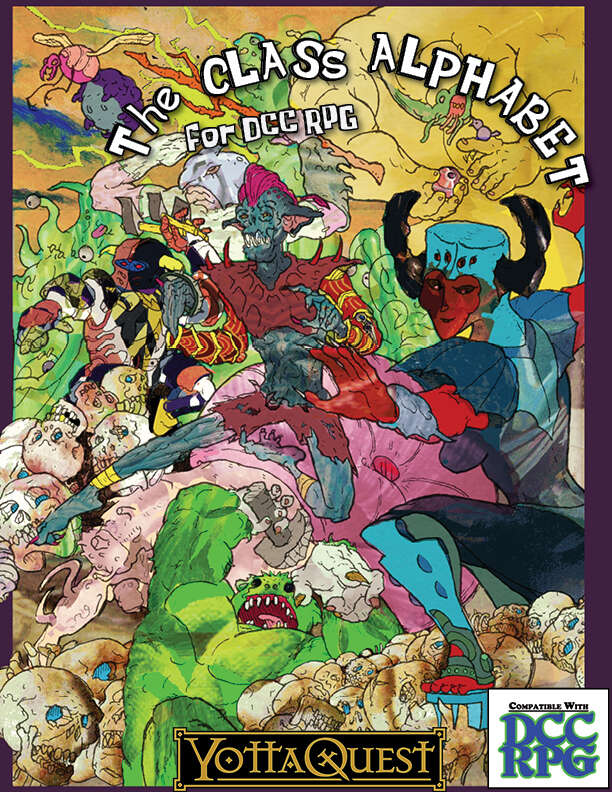
The Class Alphabet for DCC RPG

The Class Alphabet for DCC RPG was written by James V. West, Stephen Murrish, Anne Hunter, Victor Garrison, Jarrett Crader, David Baity, Julian Bernick, R.S. Tilton, Wayne Snyder, Claytonian, Diogo Nogueira, Noah Stevens, Jose SeldanaDavid Coppoletti, Jeff Goad, Jon Wilson, Reid San Filippo, Justin IsaacForrest Aguirre, Terra Fox, Anna Costa, and Rick Kammer. Art is by Danny Prescott, James V. West, Davey Parrott, Jane Elisabeth Thomas, David Coppoletti, Evlyn Moreau, Jon Wilson, R.S. Tilton, Claytonian, Diogo Nogueria, KJ O'Brien, David Lewis Johnson, Ray Otus, Karl Stjernberg, Anna Costa, and Rick Kammer. The publisher is Dungeon Remixer.

Disclaimer: I was given a free pdf from the publisher, in hopes that I would write about this product (which I would have anyway). As a result I noticed a few small edits prior to publication, which resulted in my being given a credit as an editor. My blog, Raven Crowking's Nest, is listed in Appendix III of this work.

This book, not surprisingly, contains an Introduction and a "How to use this book" section. Each is a single page long. Not all of the classes herein are going to fit well into every campaign. With 26 classes to choose from, the odds are that something will fit into any given milieu. None of these classes, however, is simply a Ranger or Paladin variant. Well, there is the Zealot....

For some reason, the publisher decided to make the pdf not only automatically default to a two-page spread, but treated those spreads as single pages. This is not ideal. Obviously, the two-page spread looks good - most pages are designed to take advantage of how one would see the pages in print - but it does make reading the pdf harder than it needs to be. At the point of this writing, a print version is not available.

Let's take closer a look at each of these classes, shall we?

A is for APE ASCENDANT: You are an ape. You are a very smart ape. You are a smart ape with primal strength and rage. You are a very smart ape with primal strength and rage that can deliver powerful psionic blasts. If you wanted to play an analogue of Gorilla Grodd, this is your chance. This is a relatively simple class to understand, taking only a single page of the book.

This class would fit into any tropical milieu with a bit of gonzo, but the PC might have a harder time visiting a tavern. This could also stand in for a yeti-type character, or a subset of Ith’n Ya’roo.

B is for BLACK CAT: Literally a magical black cat, this is nonetheless a fairly complex class which takes a full 12 pages to describe fully. The Black Cat gains spells, its own unique critical hit table, and a full patron write-up for Shammat, Lady of Cats. 

Most campaign milieus will include cats, and most societies are not at all surprised to see cats hanging around where people are. This class could gain wide usage as a result. Shammat might be an interesting patron for wizards and elves.

C is for CYBER-ZOMBIE: This class represents a dead body reanimated and upgraded with technology. Characters have to die in order to become Cyber Zombies, and not every dead character can be revived as such.

This is a complex character class that requires 7 pages to describe, including upgrades that the character might gain. In a milieu similar to Umerica or Mutant Crawl Classics, this class could fit right in. The class might be the result of PC action, or the result of technological processes beyond the characters' control - in this way, an adventure location could create Cyber Zombies as unique PCs even in a nominally medieval setting.

D is for DRUG USER: I am still amazed that Joseph Goodman let this one into the book.

A complex class taking 10 pages to describe, "You sacrifice your sanity to forces from beyond the cosmic veil in exchange for powers unknown in your birth universe. You walk a tightrope between controlling your environment and controlling yourself. If you let your guard down for just one unwary moment, or pursue an ecstatic experience just a little too far, you risk being invaded and ultimately consumed by Transdimensional Cognitive Parasites who skitter around the periphery of your reality, looking for a portal into a host consciousness in your dimension".

Ostensibly, this class could fit into almost any game setting, but including it will definitely change the tone of a campaign. Sadly, there is no mention of taduki.

E is for EDITOR: Taking up two pages, this class is designed with meta-gaming in mind. Serious meta-gaming. As in looking at the judge's notes and reporting back to the party meta-gaming. This might be fun in a one-shot, but I would have a hard time using it in an extended campaign. What else should one expect from "Jarrett Crader & accomplices"?

F is for FLESH-FORGED: This is a two-page re-imagining of Frankenstein's Monster, with an awareness that all of its parts might not actually be human. The class is relatively straight-forward and could fit into almost any milieu. With a little bit of disguise work, it might even be welcome in a tavern. I would limit the use of the class to prevent it from losing its impact.

G is for GOBLIN GANG: Another two-page class, you are literally a gang of small, imp- or gremlin-like goblins. Effectively, this is role-playing a swarm. Does it work? Well, the class is not difficult to understand, but it would have a hard time interacting with the mundane folk of your average village.

It would be easy to reskin this class to fit into almost any campaign milieu, although if the game is strongly human-centric it will not fit. They could be some form of collective intelligence in Star Crawl, Crawljammer, or Phantasmagoria. In Umerica or Mutant Crawl Classics, they would fit right in. In a game based around the Shudder MountainsDark Trails Weird Frontiers, or Transylvanian Adventures this class could represent an opponent, but probably will not be a comrade-in-arms.

H is for HELLFONT: Why allow wizards to have all the fun of demonic patrons and corruption? Now your Warrior-type character can have them too! Although not a complicated class, it does take 4 pages to also document the powers and corruptions you might have. I picture this class as being inspired by Venger from the old Dungeons & Dragons cartoon, but I could certainly be wrong.

If there are demonic patrons in your milieu, this class will fit. You might have trouble mingling with other folk, however,

I is for INTELLIGENT WEAPON: Here is an interesting idea: your PC is an intelligent weapon. This also means that you need a thrall...some feckless would-be adventurer that you can control and act through. It is a neat idea, taking three pages to detail, and is not overly complicated. Although a magical sword, axe, or hammer might be the go-to ideas that come to the average player, it would be easy to use this class in Mutant Crawl Classics, Star Crawl, or Umerica with a more technological base. Not every magical ability is easily converted to a technological ability, but transition should go smoothly with a little judicious interpretation.

J is for JOCKEY: This is a one-page class for those who might wish to ride some form of critter. It isn't complicated and, for the most part, it should translate easily to almost any game milieu. If  the idea of a PC mounted on an umber hulk is too gonzo for you, use sparingly!

K is for KNAVE: This is possibly the most complex class created for Dungeon Crawl Classics at the time of this writing. It is not surprising, then, that it takes a full 30 pages to fully describe. 

"Knaves are selfish in the extreme. They take what they want, and live off other people’s labor. Knaves take the largest slice of pie; they drink the whole pail of water. Knaves want the biggest and the best, the first pick, the choicest cut. They demand service and servitude, and anyone who stands against them gets beaten down full sore. Knaves blackmail and ambush, they burgle and break, they wheedle, they scheme, and they’ll fight to the death – but never lift a finger to do an honest day’s work."

What sets them apart, though, is service to the Arcana. The Knave has a mystical relationship to the tarot deck, They have a suit chosen from those of standard playing cards - Clubs, Spades, Diamonds, and Hearts - that helps to define their powers. In short, once more, they are complicated. Flavorful, but complicated. You will want to have this section printed out at the table if you play a Knave or have one in your game. 

Depending upon how your magic is styled, this class may or may not fit into your milieu. It would be perfect in a game inspired by Faerie Tales from Unlit Shores, but might seem out of place on the Purple Planet. Or not. It's your game.

L is for LEMURIAN: Another ape-themed class, this one being a man-ape with ancient memories but no overt psionics. Well, the picture shows a man-ape, but this could just as easily describe Brule the Spear-Slayer from Robert E. Howard's Kull stories, or some of the heroes of Lin Carter's more tongue-in-cheek Lemurian Cycle. The class is not complicated, clocking in at three pages. If your milieu includes ancient peoples in a primordial world, the Lemurians may do nicely.

M is for MONSTER TRAINER: Clearly inspired by Pokémon, this somewhat complicated class only takes three pages to describe. Unfortunately, the sample monsters from the Working Class Alphabet are not reproduced (so you had better get that as well...) but, then, anyone travelling in a DCC milieu is bound to encounter something worth catching.

Because of the obvious source of inspiration, this class might not fit into all milieus. However, the writing is good, and the class could fit into almost any game. 

N is for NINJA VAMPIRE: You are a ninja. You are a vampire. It takes two pages to describe what this means, because, after all, "Ninja Vampire" is not a hard concept to grasp. Whether or not your character fits into a particular campaign milieu is another matter. This class is particularly appropriate appearing in the ruins of Seattle in an Umerican campaign.

O is for OGRE: You are an ogre. It isn't that complicated. Your class takes three pages to describe because you get your own special crit table. You get that table because you are big and you like to bite things. There are probably a lot of campaign milieus where you can't get seated in a tavern.

P is for PUPPET MASTER: This class casts spells and controls puppets, which makes it rather like the villain of A. Merritt's Burn, Witch, Burn! This is not very complicated, but takes 3 pages to describe because the puppets themselves must be described. This class could fit into most settings.

Q is for QUANTUM WANDERER: "You are misplaced in time and space — lost, marooned, or simply not where you started — but in any case, you come from a world very different to the primitive one you find yourself on now. Though it must be said these primitives do keep finding ways to surprise you with their inventiveness. You may be moving on as soon as your etheric beam emitter is working again and your towel is dry, or perhaps this is where you’ve decided to settle long term. Or you may be searching this world high and low, in hopes of finding a way back to where you belong..."

This class takes three pages to describe and assumes that the PC comes from an advanced future. Appendix N fiction is filled with modern people become embroiled in other worlds, be they the past of their own world, or other worlds such as Mars or Venus. Here we are more into Kang the Conqueror or Booster Gold territory.

R is for RO-BARD: This is a robot entertainer. Although the class uses standard DCC class metrics, this is clearly a class that would fit well into the Umerican setting. It might also fit well in Star Crawl, Phantasmagoria, or Crawljammer. Not overly complicated, the class takes 3 pages to describe.

S is for SLIMENOID: A simple, single-page class that is also not likely to be welcome in the average tavern. "Mucal invader, is there no end to your oozing?!" Strangely, though, I could see this class working in most campaign milieus. In some, the Slimenoid would be an anomaly, but in a Mutant Crawl Classics game? Slime on!

T is for TENACIOUS D-FENDER: This is a three-page class dedicated to Tenacious D - effectively a parody of a parody. Nonetheless, it is a playable class...although playing one will very likely affect the tone of the game.

U is for UBIQUARIAN: "Everyone has wished they could be in two places at once, but the ubiquarian actually can—and some can even be in up to sixteen places at once!" It's an interesting idea for a class, and one that could fit into a great many campaign milieus. The class is not overly complex, and takes up three pages including a table for Astral Mishaps. Probably more importantly, the rules allow the class to do some unique things - including providing advanced scouting - but it should not overwhelm the table.

V is for VELOCIRAPTOR: A two-page description of a Velociraptor class. For other takes on similar classes see The Goodman Games 2017 Gen Con Program Book, Crawling Under a Broken Moon #14, Hubris, and Tales of the Fallen Empire. DCC players seem to have a thing for playing saurians. They are even part of Primal Tales.

W is for WOLF GIRL: "Bristling with primal energy, finely tuned to her territory, thriving on self-governance—the Wolf Girl is an unapologetic autarch, motivated by razor sharp instincts and a ferocious drive to survive. Her prevailing ideology is essentially solipsistic: preservation of self, and of the environs that sustain her. Threats to this paradigm are dispatched with swift brutality. Depending on her natural empathy, a Wolf Girl’s sense of self can expand to include friends and causes, which she will defend with exceptional displays of courage and sacrifice.

Wolf Girl has an inner wolf; she is a shifter, dominated by mood swings, focused anger, and unresolved trauma. Residing in the wild, she and her lupine companion are self-possessed, meditative, and stunningly savage. 

A Wolf Girl might use her connection with the earth to craft potent medicines, bezoars, and alchemical components. She might also be a master of her physical reality: platforming buildings, deflecting gunfire, and lancing targets from hundreds of yards away. Wolf Girl’s origins and motivations differ as well. The Wolf Girl is a paragon of natural balance."

This is a magical female Mowgli which takes two pages to describe. The Wolf Girl would fit into most campaign milieus, but would excel at outdoor adventuring away from the confines of both the city and the dungeon.  

X is for XENOCYTE: A two-page class that seems a bit Alien. There are game milieus into which this would fit (Star Crawl springs to mind), but I have a hard time imagining Xenocytes mingling in the tavern after an adventure, or carousing on the streets of Lankhmar.

Y is for YOUTHFUL MUSICIAN: "In every age, in every land, there have been those good souls who travel amongst the needy and who work to undo the machinations of evil. There is something about youth, exuberance, and transgressive music that stirs adolescence and young adults into travel and the championing of all that is good and right. Often, these foolhardy souls simply strive to right the wrongs caused by petty men and women against their neighbors, but every now and then they stymie the efforts of galaxy-spanning cults, supernatural beings, and weird entities from beyond the stars. They fight the good fight for the sheer reward of it, asking no recompense and wandering here and there living where the needs of Law might take them. They tend to attract weirdness of all kinds, and are frequently accompanied by talking animals, beneficent spirits, barmy obsolete robots, and all manner of other companions. Playing music is something of a side gig, or perhaps solving mysteries is the side gig - often there is no way to tell..."

This two-page class is inspired by Jeff Quick’s game Hijinx, appearing in Polyhedron #158. It is a joke class, like the Hot Dog Suit, which will definitely alter the tone of whatever game it appears in.

Z is for ZEALOT: The last class in the book is a two-page divine champion which is definitely promoting a single god. This should fit easily into most campaigns.

Appendices: The book also includes three appendixes. The first deals with esoteric rules and frequently asked questions. The second breaks down the classes into the in-game roles they fill. A discerning judge might reproduce the list from this chart to indicate which options are available in their game. An even more discerning judge might allow certain classes to become available as rewards for meeting certain Quest For It goals, or for playing through specific adventures. Finally, there is an appendix of resources, including an Alphabet of Game Worlds.

The Class Alphabet for DCC RPG introduces 26 NEW classes to your game. Each is fully playable from level 1 to 10, and there's a class for every letter of the alphabet! Within this book you will find a mythic proportion of options for any variety of game setting or playstyle. Every class has been lovingly handcrafted and lavishly illustrated by a team of gongfarming gamers from every corner of the globe. These classes will not only elevate your game to new heights of gonzo-infused frenzy, but will also inspire a multitude of ideas to help judges and players develop their own unique content.

Apes, robotic bards, quantum vagrants, shadow manipulators, monster trainers, puppet masters, ogres, dinosaurs, hellbound warriors, tenacious d-fenders, and gangs of goblins are JUST A FEW of the madcap character classes you'll discover inside. All completely illustrated with accompanying spells, crit tables, powers, and other bizarre tables of options.

Strap in, because your game is about to experience a paradigm shift and things may never again be the same!

Get It Here!


Friday, 12 June 2020

Pax Lexque Campaign Guide

Pax Lexque Campaign Guide was written by Ed Stanek and Xuân Stanek with contributions by Susan Stanek. Art is by GAOZ Artworks (cover), Xuân Stanek, and Ed Stanek (cartography), as well as public domain images (with references on page 185). The publisher is Raorgen Games.

This is a campaign setting for Dungeon Crawl Classics, which posits an alternate Earth in which the Roman Empire has to contend with the strange sentient races common to fantasy role-playing games, as well as dark magic.

Centuries ago, a "magical arms race culminating in the Wars of Darkness tore the empire apart and lay waste to much of the Great Sea region." The Great Sea being, of course, the Mediterranean. In the PC's time, a special military force, the Manus Legis ("Hand of the Law") is charged with dealing with "unexplained problems left over from the magical war cursed or haunted battlefields, horrific monsters summoned during the war, necromancers and diabolists who still try to delve into forbidden knowledge." It is likely, but not necessary, that the PCs will be a unit in the Manus Legis.

The discerning judge who wishes to include an element of time travel in their DCC campaign may decide that the world of Pax Lexque either leads directly into the world of "modern" DCC XCrawl or runs parallel to it. Either way, I could easily see a group of DCC XCrawl promoters "poaching" teams from the past, so that your Pax Lexque PCs could find themselves facing DungeonBattle Brooklyn....conversely, a diabolical cult might kidnap DCC XCrawl athletes to accomplish some task in the past/their parallel world.

After the Introduction and a historical timeline, the volume describes an Atlas of 26 separate regions:Aegypt, Aquitania, Arabia, Belgica, Betica, Britania, Cypria, Dacia, Druzix, Felicia, Germania, Hellena, Hispania, Macedonia, Mauretania, Meria, Nurdarim, Pamfilia, Roman Empire, Rome, Scythia, Semosiss, Stonarx, Syria, Talin, and Thracia. For each of these areas, geography, history, politics, religion, and daily life are described.

Regional maps are provided for each area as well, although these would be more useful with a hex overlay or at least a scale for distances. Cartography is done with Campaign Cartographer and is very clean, but it is not what DCC maps usually look like. Artwork is, similarly, not what one usually expects with a DCC product, being largely vector graphics and/or photographs with filters to make them appear painted. This isn't a serious criticism, but it is something the potential buyer should be aware of. Font and layout choices are such that this 189-page pdf could have easily fit into a more slender 100 pages - perhaps not a problem with the pdf, but something that might affect your decision to purchase in print.

As an example of an area overview:
The land of Macedonia is beautifully scenic, but badly scarred. Though not without its share of virgin wilderness, large areas of Macedonia are still reeling from the Wars of Darkness. Macedonia struggles to heal from the mistakes of its past and that legacy won’t be shaken any time soon.
The Macedonian landscape is a study in contrasts. The rockiness of the terrain may be a constant, but it takes a variety of forms. Progressing from the central mountain range, through the rocky, uneven valleys of the inland hills to the crags of both coasts, the land of Macedonia is striking to behold.
In its earlier days, the central mountains were home to many small mining villages. Today, these places are ghost towns, in some cases literally. As the Macedonian economy fell apart as a consequence of the Wars of Darkness, internal commerce ground to a halt. With very little mechanism to bring ores to market, the mines fell silent.
The coastal cities are beginning to stabilize once again as trading ports, but their prosperous days of the centuries past are behind them. With little moving in the way of local resources coming to the ports, few traders have reason to stop there. Even the once thriving capital city, Thessaloniki, is only a shadow of its former self.
The inland hills are an untapped resource. For centuries a cash cow of olive, fig and date orchards, much of this land is now inaccessible because of magic blight or extraplanar creatures left over from the wars. Most of these once prosperous orchards have been wild and uncultivated for centuries.
The text then goes on to describe the history, politics, etc. of the region.

For obvious reasons, the setting book takes some extra time to describe the Roman Empire, the city of Rome, and Roman law. As the PCs might very well be applying that law to various necromancers, diabolists, and monstrous beings, this is important. As other PCs might run afoul of the law, it is also important - it is not legal to cast just any spell, and murder hobos cannot necessarily act with impunity.

Gods and Patrons

Pax Lexque has a unique (and interesting) take on gods and patrons. There is no difference between the two, and all clerics can cast patron bond. Patron bond is a little more powerful in this setting as well, and when a cleric casts it, the recipient might receive a modest boon in addition to the normal effects. Clerics also gain access to the patron spells of their gods.

One of the results of this is that the Pax Lexque Campaign Guide contains a number of new patrons for players and judges to play with. Spellburn functions differently. I.e., a "full patron write up" in this case includes notes on how Spellburn operates for the patron, but not an actual table indicating how Spellburn manifests.

The patrons are:

Celata -­ Whisperer of Secrets: Celata is the one who knows the unknowable, that which is hidden away from mortal eyes. She whispers in the dark places to her faithful, giving them visions and understanding. Caves, springs, and thermal vents are sacred to her as are the wombs of women, for what is more mysterious than the knitting together of life?

A full patron write-up is provided.

Doraga -­ Master of the Forge: Deep inside an unfathomably large mountain is the monstrous forge of Doraga, Lord of the Dwarves, Master of the Forge. Every volcano that erupts is the stoking of his bellows. Every earthquake echoes the beating of his hammer. Near the dawn of time, Doraga forged the first dwarves from iron and molten stone. As his craftsmanship, they reflect his very persona. When a dwarf works a forge and smiths a piece of metalwork, he is engaging in an act of piety, reflecting the spirit of Doraga.

Doraga does not normally have arcane patrons, so there is no Spellburn information. The patron write-up is otherwise complete.

Eliha -­ Father of the Wind: The father of all djinn, Eliha, has made his presence known in Arabia since before the recorded history of that land. Every dust devil that skirts along on the desert sand is said to be one of his messengers. Generally, Eliha’s influence is seen as helpful as his westwinds bring moisture off the Great Sea. However, his temper is known to flare as sandstorms that rage across the land. Just as the wind is unpredictable, so Eliha is enigmatic. This should not be confused with being chaotic however. By contrast to Labul, whose focus is seen solely in destructive, chaotic storms, Eliha is measured and balanced, sometimes wrathful, sometimes gentle. His unpredictability is seen more as a difficulty in mankind knowing the mind of the djinn than an indication of chaos.

Basic description only.

Elkev ­- Master of Flame: The brother of Eliha is Elkev, the father of all efreet (or ifrit). Elkev’s name inspires both reverence and fear. In Arabia and Syria, Elkev is seen as the source of the sun’s fire, which is recognized as necessary for life. As such, he is celebrated for providing light and warmth. On the other hand, those who invoked Elkev recklessly in Arabia’s war against Rome caused great damage to the land. On the balance, the people of Arabia fittingly approach Elkev the way one handles fire, with care and respect.

Basic description only.

Ellelliara -­ Light of Dawn: To the elves of Hellena, beauty is a way of life and a cornerstone of their culture. Nowhere is this more evident than in the person of their national patron, Ellelliara. According to Hellenic tradition, when the world was fresh and very young, Ellelliara gazed upon it and was pleased with its beauty. She rode a sunbeam down from the sky to walk among the forested shores of that land that would become Hellena. As she walked along the green fields, in each of her footsteps sprang up flowers orchids, hyacinth, crocus. Sweeping her hands through the grass as she walked, the taller grass stalks became seedlings, growing in the breeze behind her jacaranda, fig, pomegranate. Reaching an overlook of the rocky coast, she looked back on the new garden that had sprung up in her wake. Tears of joy dropped from her face as she was overcome by the beauty. As the teardrops hit the ground, they sprang forth into the first elves her children.

A full patron write-up is provided.

Fortruvius ­- Lord of Valor:  Integrity. Respect. Ritual. Discipline. Courage. Perseverance. Honor. Pursuits of these virtues lead to glory. Glory in battle. Glory over one’s enemies both internal and external. Glory everlasting. Those dedicated to Fortruvius commit themselves to a continual regimen of self-improvement and set themselves the task of becoming exemplary.

A full patron write-up is provided.

Gulyabani ­- The Hidden One:  Sometimes called the King of Guildmasters, Gulyabani is patron of goblins and thieves. Most of the humans who secretly follow Gulyabani do so seeking favor in their pursuit of larceny. To the goblin folk, following Gulyabani is far more than that. He is their master who drives them on in their war for survival against the big folk. It is he who inspires their ruthlessness and teaches them that anything they can take, they deserve to have. Every raid on a human caravan is an act of identity for them, and an unspoken act of worship to the one who taught them to strike from the shadows.

Basic description only.

Helet -­ Chief of the Hunt:  Helet the hunter is revered by the Celtic people. His teaching, “You must know your quarry before your quarry will know death” is learned well by rangers of the Great Gaulic Forest. Though his followers take great pride in a hunt well done, a hunt is never to be undertaken for sport. Legend has it that overzealous hunters will become the hunted, stalked by one of Helet’s wolves.

Basic description only.

Iber -­ Father of Peace:  The people of Hispania and Betica tell of a time in the unknown past when Iber pulled the Iberian peninsula out of the churning waters, with the specific purpose of creating a place of peace and harmony. He then sculpted the earliest Iberian people from the land and tasked them with maintaining the peace of this new land. Iber is generally thought to not be particularly involved in the events of the land now, leaving that task to his people. It is said though, that he does watch the realm from a distance, ready to nudge the scales should anything in the land tip too far towards chaos. His followers are ever watchful that the proper order of the world is maintained, including an eye towards a stewardship of the natural world. Things that are deemed unnatural, such as undead, are the greatest anathema to the Iberian outlook.

Basic description only.

Labul -­ Anger of the Storm:  Not simply a patron of the air or of rain, Labul is specifically the Master of Storms, violent raging destructive storms. While some who call on him do so in an attempt to appease the Anger of the Wind, many of those who seek his attention are seeking to cause destruction. Certainly during the Wars of Darkness, the Lord of Lightning was called upon by many to wreak havoc on enemy armies or even to lay waste to civilian populations. Labul is a wild and unpredictable patron, and those who wish to draw his gaze and channel his power do so at their own peril.

Basic description only.

Mordines -­ The Shadow of Death:  The Master of Darkness, the Dark Veil, the Stalker in
secret he is still worshiped in hidden places throughout the great sea. The reasons for his ongoing influence vary. For some, it is simply to seek a divine stamp of approval on the evil they wish to work, but others are true believers in his call. They believe he is the master of all, the highest of the immortal beings, because death eventually comes for every man. Even the long-lived elves eventually fall under his axe. It is said to be Mordines who gives power to the undead, that by his hatred of life the restless dead will not find peace. Those who follow Mordines consider it the ultimate blessing and sign that he has approvedtheir work if, upon their death, they continue to malevolently stalk the land of the living.

Basic description only.

Mothir -­ King of Battle:  The Germanic tribes of the northern wilds have various patrons, but the most commonly revered is Mothir, the Father of Courage and Judge of the Battlefield. There have been those who erroneously have thought that Mothir is simply a Germanic name for Fortruvius, but the two patrons are actually quite different. While Fortruvius also promotes courage in battle, his focus is on valor, honor, and self discipline. Mothir, as reflected by Germanic culture, is focused on the ferocity of battle. He is well represented by the legendary berserker warriors of the Germanic tribes. All of this does not mean he is outright evil. He does not necessarily champion cruelty and bloodlust. However, once the battle is joined, he does expect his people to fight with all their heart and soul.

Basic description only.

Procella -­ Mistress of the Waves:  Almost everyone who sails the seas or lives on the coasts around the Great Sea gives at least token respect towards Procella. She is the embodiment and personification of the Great Sea, and her character reflects the range of what the sea means for those who live on it life-giving through its supply of fish and transportation, but occasionally treacherous with an unpredictable storm. There is debate among scholars and even among her clerics whether Procella is simply the patron of the Great Sea, or actually is the Great Sea. To most of her followers, the distinction is fuzzy. They tend  to see the relationship between Procella and the Great Sea as being one of those things that is too lofty for mortal minds to comprehend.

A full patron write-up is provided.

Ramasar - The Untamed One:  The centaurs who rule over the vast open plains of Scythia and their horse riding neighbors in Dacia, revere the paragon of equines, Ramasar the Swift. Said to be faster than any other being on the earth or in the heavens, Ramasar is the soul behind the way of life on the northeastern plains. Their shared reverence for Ramasar has created an ongoing bond of brotherhood between the humans in Dacia and the centaurs in Scythia. It is very common for the two to meet at each other’s annual festivals to come to each other’s aid in times of need. The Stallion is said to have only one herd on the earth, and all who look to him are considered part of that family. Ramasar promotes dedication to family, tribe and tradition as well as being at peace with the natural world. Speed in running is considered a mark of Ramasar’s approval.

Basic description only.

Reku ­- The Light Giver:  The people of Aegypt have a recorded history longer than any land other than Hellena. Throughout the 7000 years of their civilization, their primary patron has been Reku. Reku is the personification of the sun. His light is his blessing on all people. He withdraws that blessing at night so that mortals will understand the gift they have been given by the contrast of its absence. The people of Aegypt believe that the earth has always existed but that there was no life on it until Reku first shone forth upon the land. Suntanned skin tone is considered to be a sign of closeness to Reku. Legends tell that further south of Aegypt there are people born with skin far darker than any Aegyptian. These are spoken of as Reku’s first children. Reku calls upon his followers to live orderly lives, as his course across the sky is predictable, and to give generously to each other, as he gives generously to them.

Basic description only.

Savra -­ The Scaled One:  The generally recognized correct name of Savra is not pronounceable by humans, nor readily represented in any humanoid writing system outside the lands where she is worshiped. As an adaptation, the name “Savra” is derived from the elven word for lizard. Savra is revered in the lands of Druzix and Semosiss by the lizardfolk and serpentines respectively. Each of them represents Savra as a female of their own type and insists that the other group has misrepresented her. Some human scholars claim that Savra is actually a dragon. Regardless, Savra herself does not seem to have clarified the matter, so the debate will likely not be resolved. Savra is an advocate of order and structure and this is evidenced in the highly regimented, caste-based societies of both Drizix and Semosiss. Savra’s followers believe it is a living service to their patron to seek to fulfill their allotted role in society and not to seek to change the status that Savra has assigned to them. 

Basic description only.

Senet -­ The Eye that Sees:  He is the eye that sees the old things, the forbidden things, the things that man was not meant to see. The second pharaoh to rule over a united Aegypt, Senet II delved into the secret ways of the foundation of the world. He and his cabal of sorcerers researched and studied, testing ways to tap into the energies of the world by trial and error. How this got started is uncertain. Some records seem to indicate that a spirit of some kind, perhaps demonic, perhaps a ghost, whispered to Senet about power that could be his. For a decade, the pharaoh and his inner circle discovered new and more powerful magics and summoned progressively more powerful beings from outer realms. And then it ended somehow, suddenly it all just ended. The historical record of Aegypt gives no details. The record of Senet simply stops as though mid sentence to be followed by his successor with no mention of magic again. There is no record of how Senet died. His tomb, underneath a pyramid in the desert, many miles from any city, was avoided by all for 6000 years. The people of Aegypt never even spoke of it, except to tell foreigners to stay clear.

Basic description only.

Tanalis ­- Lord of the Forest:  While many patrons are believed by their followers to have created them or their homeland, with Tanalis, the opposite is true. The elves of Aquitania believe that the forest formed as the world was birthed, that it is the natural state of being for their land. It wasn’t Tanalis who produced the forest; it was the forest that produced Tanalis. In the earliest of days, when the trees had grown and the animals sprang forth from the land, the forest had a will and a consciousness of its own, a consciousness that is now asleep. Before she slumbered, sensing that her thoughts were fading, the forest knew that she would need protectors. Thus it was that she birthed the first wood elf, Tanalis, making him immortal to watch over her forever. Pleased with what she had produced, she brought forth 120 more, 60 male and 60 female. Her energy already fading, these were lesser than Tanalis. She could not make them immortal, but she gave them lives as long as her greatest trees, so they would understand what they were protecting. Since then, Tanalis has guarded over both her and her children.

A full patron write-up is provided.

Ubaste ­- Feline Mother:  Patron of the felids, the cat people of Felicia, Ubaste is represented by her people as a golden-furred female of their kind. The people of Aegypt also revere her and consider the felids to be Ubaste’s chosen people, a contention naturally echoed by the felids. Ubaste is also often looked to for blessing by merchants. She is seen as a mother figure, though a rather distant and aloof one, who brings wealth and prosperity to those who please her.

Basic description only.

Judges may wish to round out their campaign by using materials from Divinities & Cults Volume I and Volume II.

Classes

Four new 10-level classes are included in this tome. They are:

Dwarven Cleric: The culture of the dwarves is heavily invested in ritual, heritage and tradition, so it is of no surprise that the dwarves hold tightly to the faith of their fathers. The dwarven cleric is a key part of passing down the heritage for each generation. Also, the dwarves often find themselves in conflict with the darker denizens of the underground. In these cases, the dwarven cleric is integral to the ongoing durability of the dwarven armies.

For other takes on dwarven clerics or priests, see Crawl! Fanzine #10 and Gygax Magazine #3.

Elven Ranger: More combat-oriented elves from Aquitania.

Felid: The natives of Felicia are a bipedal feline race called the Felids. They are typically known as a people who live for the moment, with little concern for long term matters. The stereotype of the hedonist felid, focused only on enjoying the finer things in life, is an exaggeration, but does have some roots in reality.

For other takes on animal people, see Bronx Beasts, Mutant Crawl Classics, and Primal Tales #1.

Gnome: The small folk who dwell in Cypria and Pamfilia, the gnomes, are about the same height as halflings, but tend to be a bit slighter of build. Their diminutive size, however, can be misleading. Gnomes have more than a few tricks up their sleeves (sometimes literally) to dissuade would be enemies. Gnomes are quite skilled at a range of innate magic, especially illusions, automatically having access to some spells.

For another take on gnomes, see Crawl! fanzine #6 (reprinted with some expansion in Gnome Jambalaya).

New illusion spells are included to support the gnome, although they are not limited to that class. They are hallucination (level 1), greater illusion (level 3), and ethereal illusion (level 4).

Pax Lexque is a campaign setting based on an alternate reality historical earth in which the Roman Empire was co-mingled with conventional elements of fantasy - elves, dwarves, wizards, clerics, giants, dragons and everything else you’d expect.

After a magical war tore the Roman Empire apart, the empire is now rebuilding, with its eyes on its eternal motto, “Pax Lexque” or “Peace and Law”. The campaign's starter modules (The Hand of the Law) place PCs in a special forces arm of the imperial army. Their squad is sent on missions to deal with unexplained problems left over from the magical war - cursed or haunted battlefields, horrific monsters summoned during the war, necromancers and diabolists who still try to delve into forbidden knowledge.

This guide is meant as a sandbox environment. The world of the Great Sea region is presented with its history and geography broken down to twenty nations, ready for characters to explore. Nineteen new patrons particular to this world are described, six of which are presented in full detail, complete with patron spells. Also included are four new character classes: Dwarven Cleric, Elven Ranger, Felid (or catfolk) and Gnome.

Get It Here!