Showing posts sorted by relevance for query Transylvanian. Sort by date Show all posts

Monday, 8 August 2016

Crawl! fanzine #8

Crawl! fanzine #8 was written by Reverend Dak with additional writing by Mike Evans, Austin Schaefer, Christian Sturke, and S.A. Mathis. This issue, published by Straycouches Press, focuses on Firearms! Unusually, this issue is also available as Hack!, designed for the Swords & Wizardry (and therefore other OSR) rules. I do not own the Hack! version.


Actually, the Hack! version came about first, as Reverend Dak explains in the introduction, as the result of a Tenkar's Tavern post for Swords & Wizardry Appreciation Day. Either way, those of us playing Dungeon Crawl Classics certainly benefit as a result! If you get any singular firearms reference for DCC, this is the one to get.

So, what's in this issue?

Firepower!

Basic and optional rules for firearms. These are solid rules that help recreate the feel of using firearms in any campaign setting.

Different Eras of the Firearm

Mike Evans and Reverend Dak take you from the "Era of Powder and Smoke" to the "Era of Lasers and Rockets" with full stats for various weapons and ammunition.

Invasion!

An "adventure toolkit" that allows you to build an invasion of firearms users to bedevil your DCC PCs.

Appendices

  • Appendix I: Invaders! - Mike Evans provides stats for five groups of invader, ready to be used in your adventures.
  • Appendix R: References - What it says on the tin. RPGs that use guns, which can be used for reference.
  • Appendix S: Submissions - The Six Shooter, an artifact-caliber revolver by Austin Schaefer and simple rules for Explosives and Bombs by Christian “Rorschachhamster” Sturke.
  • Appendix T: Firearm Crit & Fumble Tables - Provided by S.A. Mathis of Transylvanian Adventures fame.

Wednesday, 23 May 2018

The Ghoul Prince

The Ghoul Prince is a 2nd level adventure by Zzarchov Kowolski. Art is by Alex Mayo (including cover). Cartography is by Dyson Logos. The publisher is DIY RPG Productions.

Disclosure: I have been offered a print copy of this product for free in exchange for this listing. I paid for the pdf version, and I would have made this listing anyway.

This adventure begins with an interesting premise. Note that I am not talking about the premise of the adventure itself, but the premise of how the adventure is written. The author writes:

"So this adventure is starting with a weird question I’ve been playing around with: how easy can you make it to slot a published adventure into the wildly different campaign settings of actual tables, without destroying all the flavour and actual value of that adventure as a useful tool."

"The idea is that there is a central frame of an adventure with a lot of set dressing that is used to cement it into a setting. The frame of the adventure is unchanging, while the set dressing is specifically labelled with an accompanying index so the GM can reference
notes with what is on the page.

These are not just cosmetic changes, and they do impact the play of the game."

This is an interesting framing device, but it takes space to convey. Examples of using this adventure location as a barrow, a desert tomb, and an alpine mausoleum are provided. There is space to create your own frame using these as examples. To make better use of the adventure, consider using the alternative frames when devising other sites of your own. By using bits and pieces of a given frame across several adventures, you can get full value for those you do not include as part of your version of The Ghoul Prince proper.

The Ghoul Prince himself is a great adversary, and is given appropriate (but easy to use) mechanics to promote his role in the adventure. The judge will may have to create stats for some creatures, although the author took this into consideration and offers the judge easy ways to avoid it.  Still, I prefer full statblocks be included for all creatures, and there lack herein is the only serious failing I see with the adventure as written. On the other hand, this does make the adventure easier to adjust for other level parties.

Overall, monsters and setting elements are good and flavorful, but if the judge doesn't do her prep work, she may find herself flipping pages - a lot! - during actual play. The pdf is password-protected, but content copying is allowed, so it would be possible to cut & paste the details you need into a single document, and then print it before game time. I would recommend this. I would also take the time to copy statblocks you might need from the core rulebook so that you don't need to look them up at the table.

By introducing some holograms and medical-superscience, this would also work well as a Mutant Crawl Classics adventure. The framing set-up would allow it to work with Crawljammer, Umerica, Transylvanian Adventures, or any other setting you might wish. It would even work well in something like Nowhere City Nights or the Brimstone of Black Powder, Black Magic.

The adventure also includes a full patron write-up for the Bone Lady: "a powerful demon that takes the form of an old crone. She haunts the wilderness around the tomb (in a regional sense) and appears only at night. When encountered or summoned, she will be next to a magically appearing crater filled with bones that she stirs and tends with a long pole. Anyone who peers into the pit to see its contents must make a DC 12 Will Save or be driven to dig out their own skeleton and add it to the pit, becoming frantically obsessed with doing so." 

This patron does not grant unique spells, but offers ones which already appear in the core rules.

Get It Here!


Wednesday, 10 August 2016

Crawl! fanzine #10

Disclaimer: I have an article in this issue.

Crawl! fanzine #10 is written by Rev. Dak J. Ultimak, Jeffrey Tadlock, Daniel J. Bishop, Colin ChapmanBrad Littman, and Noah Stevens. It is published by Straycouches Press. The theme is "New Class Options!"

Within it we find:

Dwarven Priest

You will remember how Crawl! fanzine #6 offered you some new classes? Well, Jeffrey Tadlock offers you an alternative to the race-as-class system Dungeon Crawl Classics uses for demi-humans. Your dwarf gongfarmer might survive to become a full-fledged Dwarf. Or she might become a Dwarven Priest.

Elven Rogue

Similarly, your elf might become an Elven Rogue instead of just an Elf. Reverend Dak J. Ultimak supplies a new class.

Halfling Burglar

Rev. Dak's expansion on the standard Halfling class.....

Halfling Champion

...is followed by an alternative Halfling class, also by Rev. Dak J. Ultimak.

Now, I actually have some problems with these classes. They seem to give extras to PCs at very little, or no, cost. If a Dwarven Priest is almost always superior to a Dwarf, why play a Dwarf? Likewise the Elven Rogue, and especially the Halfling Burglar. If you feel that the original classes are underpowered, this isn't going to be a problem for you. If you thought the original classes were relatively well balanced, you might be having flashbacks to AD&D 1st Edition, where the multiclassed demi-humans were obviously superior to your human fighter. Unlike AD&D, though, there is no XP penalty to even things out.

Half-Levels

This article is an optional multi-classing system which I created to answer the same problems that the three classes above sought (at least in part) to address: At some point, players ask why their halfling cannot become a thief. Or why their warrior cannot also become a cleric.

The article, which was originally written with Crawl! fanzine #6 in mind, includes information for all the base classes, plus those introduced in that issue.

The basic idea is to introduce some cost in exchange for flexibility.

Not Just A Pretty Face

A series of charts to randomly determine physical traits, such as height, weight, and hair color, by Colin Chapman. This is useful not only for PCs, but to remind the Judge that NPCs should not all look the same.

Three Weird Races

The final article is a "spotlight on three of many 3rd-Party races" compiled by Noah Stevens. A basic description is given of the Transylvanian Adventures Half Breed by Scott Mathis, the Avarian of the Hubris campaign setting by WrathOfZombies, and the Faerie Animal by Daniel Bishop, from Creeping Beauties of the Wood. Yes, that last one is mine.

Tuesday, 20 March 2018

Crawl-thulhu Issue 1

Crawl-thulhu: A Two-Fisted Zine of Lovecraftian Horror Issue 1 was written by John Potts and illustrated by Todd McGowan. The publisher is Discerning Dhole Productions.

This is the first issue of a zine seeking to combine the Lovecraftian Mythos and two-fisted pulp action in a 1920s milieu...which means that you might even survive with most of your sanity intact! Not that you should count on it in this issue, wherein you create 0-level characters and go through a funnel adventure.

Let's look inside.

Introduction: Standard fare.

Pulp Action in the 1920s: Because this zine is focused on Dungeon Crawl Classics-based play, your PCs may survive.

New Rules: There are some new rules that bring the flavor of the Mythos and the era to the table. These are:

  • Luck is for the Sane: You have Sanity instead of Luck. After 0-level, there are ways to restore Sanity. When you run into Mythos creatures, or catch glimpses of the true nature of the world, you make a Sanity Check and might go insane. Going insane doesn't end the game for you, though, except in extreme cases. When you fail a Sanity Check, you roll an Insanity Die of various sizes to determine what happens to you.
  • Firearms: It's the 1920s. They have guns. You can have guns, too.


Fight Against Impossible Odds: This is a section on how to create 0-level characters for the Crawl-thulhu setting. There is a section on Common Names in the 1920s, which adds to the flavor of the game, Occupations, and Celestial Alignment. Celestial Alignment replaces a normal DCC character's Lucky Sign, and can not only modify certain preset rolls, but results in a +1d Action Die shift on rolls against creatures related to the indicated planet/star regardless of your actual Sanity. Otherwise, the modifiers are based on your current, not your initial, Sanity.

A Horrible Day at the Dunwich Fair: What is a new Dungeon Crawl Classics milieu without a funnel adventure to start you off in? This adventure is an adaptation of H.P. Lovecraft's The Dunwich Horror (which the judge should read), and sees the titular creature rampage across Dunwich.

Commune with Yog-Sothoth: The first spell that the PCs come across, and it reveals how casting will work in the Crawl-thulhu milieu. Casting it requires a Sanity test (check), as one might expect. A natural "1" causes you to lose the spell and your mind (all Sanity). Failure causes Sanity loss, and the spell is lost for a whole month rather than for a single day. The Insanity Die size is the Crawl-thulhu version of spell level.

Next Issue: Slated to contain six classes, skills, magic, and information for setting up Crawl-thulhu campaigns. That's pretty ambitious for a second issue, and I would not be surprised if part of that appears in a third (or even a fourth!) issue instead.

A Crawl-thulhu character sheet is also provided.

Okay, with that out of the way, let's talk about this product in relationship to existing Dungeon Crawl Classics materials. Could you run a Crawl-thulhu scenario using Transylvanian AdventuresDark Trails Weird Frontiers, or Black Powder, Black Magic as an engine? Every indication suggests that you can. You could even mix and match the rules you prefer.

The funnel, A Horrible Day at the Dunwich Fair, has a lot in common with The Arwich Grinder, which is also based heavily on H.P. Lovecraft's work. You could easily run the funnels together as part of a larger scenario, if you liked, either converting the Crawl-thulhu materials to standard Dungeon Crawl Classics or vice versa.

There are quite a few other Lovecraftian resources for Dungeon Crawl Classics that might be usable with Crawl-thulhu. Probably the most apropos of these are Lovercraftian Monsters for Dungeon Crawl Classics and The Thing That Should Not Be, both by Jon Hook, and both in the Goodman Games Gen Con 2017 Program Book.

Welcome to Crawl-thulhu, where you will scour quaint, corrupt towns and forgotten catacomb for cults and monsters bent on the downfall of humanity; sacrifice your sanity to cast reality-bending spells that your mind was never meant to know; travel to strange, alien dimensions and planets; and put your body, mind, and very soul on the line to keep the Great Old Ones’ plans on hold so mankind can live another day. Crawl-thulhu requires ownership of the Dungeon Crawl Classics rulebook.

Get It Here!

Monday, 11 October 2021

They Served Brandolyn Red

The DCC 2015 Halloween Module: They Served Brandolyn Red is a 0-level funnel adventure written by Stephen Newton. Art is by Doug Kovacs (cover and cartography), Bradley K. McDevitt, and Stefan Poag. The publisher is Goodman Games.

This module is dedicated to Michael T. Frezzo.

This listing describes the original, digest-sized release of this adventure. Originally released as the first Halloween DCC adventure from Goodman Games, it went on to become the inaugural offering in the DCC Horror line.

It has been said that good adventures start with good stories, and I take that to mean the story that seeded the adventure rather than the story that the PCs will follow. Horror adventures often make strong use of this, as horror tends to be about uncovering the sins of the past as much as it is about trying to defeat the fears of the present. They Served Brandolyn Red does this very well.

The other major component of horror adventures is the Terrible Thing That Can Happen To You. Funnel adventures have a lot of death, but the Terrible Thing usually has to do with survival. As a result, most horror adventures focus either on one of these components or the other. It is easier to link characters to backstory in funnels, and easier to include Terrible Things once a character has reached level 1. There are a few adventures which do both of these things extremely well, but they are rare.

In the case of They Served Brandolyn Red, the author leans into the backstory. The adventure utilizes family trees, tying initial PCs into the adventure's background. It begins with a wedding, and as marriages are critical to the backstory, this gives a nice thematic tie-in. The story also ties directly into DCC Horror #4: The Corpse That Love Built. These two adventures are very much in the Gothic Horror genre used by the Hammer Horror films, which would make this adventure usable in Transylvanian Adventures with a few changes.

They Served Brandolyn Red was the featured adventure on the third episode of the Sanctum Secorum podcast. It is also discussed in a few other episodes. It is also mentioned in Episode 59 of the Spellburn podcast. You can find another review here. You can read more about the adventure from the author here.

The village of Portnelle is once again bright and festive. After years of feuding, the town’s most prominent and influential families will finally be making peace as the youngest generations are joined in marriage. However, when an evil born of dark secrets refuses to stay buried, blood will flow like wine at the reception.

This wedding is one your fellow villagers will talk about for generations!

The original version of this adventure is no longer available, although the DCC Horror version is.

Wednesday, 10 May 2017

The Headless Horseman

The Headless Horseman is a 2nd level adventure by Oliver Korpilla. Art is by Bernd Jans, Earl Geier, Michael Scotta, Elizabeth Porter, The Forge, Bradley K. McDevitt, and Gary Dupuis. The publisher is Mount Parnassus Games.

This adventure uses the Effect Engine System (author Sarah Newton). The link to the EES SRD in the product is broken, but it seems to be a method for organizing information within an adventure so that it can be accessed and used by the Game Master in a quick and easy fashion.

If so, it is an unmitigated success in this adventure.

(Yes, in Dungeon Crawl Classics the Game Master is the Judge, but the Effect Engine System is not game-specific.)

The storyline here is excellent, without being in any sense a railroad. The section on The Living Map (with evocative locations) is cool, so long as the judge remembers to map these locations as play occurs for the sake of consistency. I rather like the Horrors of the Enchanted Forest, and in particular the Delusion Newts. There is a lot of information on staging these encounters, including how to evade them.

There is a note that the adventure might work well in conjunction with the setting of Transylvanian Adventures, and I concur wholeheartedly. It would also work well in the Weird West of Dark Trails Weird Frontiers or Black Powder, Black Magic. I would also recommend this adventure as an add-on for anyone running the Faerie Tales From Unlit Shores series.

Beyond the shadow of a doubt, what the author and publisher are doing here is different from what other Dungeon Crawl Classics adventures provide. That is actually a great reason to grab this one up...It is a solid offering, well-organized, and which can be played in one or two four-hour sessions.

Get It Here!

Tuesday, 27 March 2018

The Dweller in Dreams

SH1 - The Dweller in Dreams is a 0-1st level adventure written by Scott Hill with illustrations by Brett Neufeld (cover), Matt Morrow, Keith Curtis, Rick Hershey, and William McAusland. The publisher is Purple Duck Games.

Disclosure: I have an Editing and a Development credit for this product, and I am a Patreon.

This is a relatively recent release, at the time of this writing, so I will avoid spoilers as much as possible. The adventure makes use of a dreamscape, and begins with the PCs as children. Ian Fleming's Chitty Chitty Bang Bang is an obvious influence, although it is the darker parts of the movie that inform the adventure.

The Dweller in Dreams is given a full patron write-up herein, which could potentially be used in conjunction with PC or NPC wizards and elves. The adventure suggests four additional hooks for further adventures, and could easily be used in conjunction with Through the Cotillion of Hours and Stars in the Darkness to create a dream-centric theme running behind a Dungeon Crawl Classics campaign.

This adventure could easily be adapted for use with Transylvanian AdventuresDark Trails Weird Frontiers, or the Brimstone of Black Powder, Black Magic.

“In Ravenhollow the fog is black, if the Dweller doth catch you, you won’t come back!”

Children’s rhymes, notes from beyond, mysteries and madness are waiting for you in the tiny hamlet of Ravenhollow, where a group of souls have been taken through time and space and left in the bodies of children, to face the peril of the Dweller in Dreams, a demon threatening the realms of all who would foolishly summon it. Dare you try to survive terrifying town, fearsome forest, and harrowing haunted house to defeat the demon Dweller and return to reality?

Get It Here!


Sunday, 24 April 2016

50 Fantastic Functions For The D50

Described as “A book of random tables and inspiration for fantasy and sci-fi gamers who love cool dice!”, this Goodman Games product is obviously best used with a d50. In a pinch, you could use a d5 for the 10s place and a d10 for the 1s place. Or you could use d% divided by 2.

Full disclosure: I am one of several authors, along with Steven Bean, Jobe Bittman, Tim Callahan, Michael Curtis, Tom Denmark, Jon Hershenberger, Jon Hook, Edgar Johnson, Doug Kovacs, Brendan LaSalle, Brad McDevitt, Peter Mullen, Stephen Newton, Terry Olson, Stefan Poag, Harley Stroh, Jim Wampler, James M. Ward, and Colonel Lou Zocchi. Just looking at that list of names, you have to know that there is something here for everyone. But this blog is about products for the Dungeon Crawl Classics role-playing game, so I am going to focus on the book from the point-of-view of the harried DCC judge.  There are 112 pages of content, and tables on the inside of both front and back covers, so even doing that is going to be necessarily brief.

What I Worked On

50 Minor Mishaps and Windfalls: I suggested the table, which others completed. In DCC, you are encouraged to ask for Luck checks periodically to determine random bits of good and bad fortune. Here you have a table that allows for these effects to come into play. May in encourage you to expand for additional effects, and local effects.

What has it got in its pockets? 50 Pickpocketing results: Many of these are not earth-shattering, because generally people do not carry Rings of Power in their pockets. This is useful for just random trolling by the thieves in your group, because you know they are going to try their luck. You can never have too many pickpocketing results tables.

D50 Venomous Creatures: A no-brainer, really. This expands the list of poisons from Appendix P to include real-world animals. I tried to put real-world effects into game terms, using the Appendix P samples as a guideline. In real life, you won’t survive as easily as your PCs do, so do not take this as a guide for what to keep as a pet!

50 Fantastic Faeries & Nature Spirits: I was going to give them full DCC statblocks, but no one wanted a single table to take up 10 pages of the book. It isn’t a monster manual. These might give the aspiring judge a place to start from in creating fey-type encounters, though!

Best of the Best

If you are like me, you are wondering, “Will this book improve my DCC game?” The answer is yes. I am going to give you five reasons why. These are not the only reasons, and others might choose different “Best of the Best” lists. As I said, there is a lot of material here.

50 Minor Mercurial Effects for DCC (Brendan J. LaSalle): Did your wizard roll a 41-60 on his Mercurial Magic result? Why should she be left out of the fun?!? Here is a d50 table to replace that “No change” result. These are very minor changes to the way a given spell works, for the most part, but some of them are pretty cool. We just started using this in my home game last week, and it has proven itself popular.

d50 Potent Poisons (Tim Callahan): Whether you intend on using them directly, or to inspire your own twisted creations, this table offers fifty baleful substances which show how creative the poisoner’s art can be. Not only are the effects cool, but the names are evocative. Good luck looting your friends after they succumb to the Seventh Pokeberry of Cryax!

Fifty Community Customs: Quaint, Cute, and Occasionally Creepy (Bradley K. McDevitt): There are a lot of great d50 tables in the book to help you flesh out characters, adventures, and locations. I picked this one because it is often difficult to make towns and villages stand out. Or it is difficult to remember to do so. This table will help.

50 Antique and Modern Handguns (Jim Ward): The core rules for Dungeon Crawl Classics encourage you to consider time travel. Several modules and settings allow for the use of firearms – Transylvanian Adventures, Crawjammer, Crawling Under a Broken Moon, and Black Powder, Black Magic at the very least. I will be shocked if there are no firearms in Mutant Crawl Classics. What about Frozen in Time or Beyond the Silver Scream? Whether you are considering a duelling pistol or a Ruger LRC, a black ray revolver, a derringer, or a hand crossbow, this table has you covered. Caution: Some of these weapons are too deadly for general use in the average campaign!

d50-Fueled Ultra-Quick Stat Block Generator (Terry Olson): Generate a creature statblock in a single d50 roll. Why? Because coming up with unique opponents is a staple of Dungeon Crawl Classics, and this gives you basic stats, forcing you to decide what they mean. And it’s fun. You can spend an afternoon using this method to devise distinctive monstrosities to throw at your players. You can also use it to generate monsters on the fly, if you must.

A Note on Drop Tables

This book contains two “drop tables”, where the page location and orientation of a dropped die are used to determine some random information. The binding on the book, however, does not make it easy to lay it flat. My completely unofficial and unendorsed suggestion is to photocopy these pages (or print them from the pdf), in one case onto 11 x 17 paper. If you wish, laminating the copied/printed page will make it last a lot longer.

Stefan Poag’s Faces in the Crowd drop table will certainly be a staple resource in urban adventures for years to come.

Conclusion

The tables I already discussed make this work valuable beyond its cover price, but there are a lot more in here, and many of them excellent. Did I mention 50 Eldritch Gateways (Jon Hook)? Did I mention Harley Stroh’s d50 Assassin or Eldritch Tower Generators? I did not. But I could have, because if you get this book, you are likely to use them. And you are going to wonder why I didn’t mention some other table, which will be among your personal favourites.

Finally, don’t imagine that, just because a table is designed for Metamorphosis Alpha that it can’t be used with Dungeon Crawl Classics.

It can be. It will be.

Get It Here

Sunday, 27 December 2020

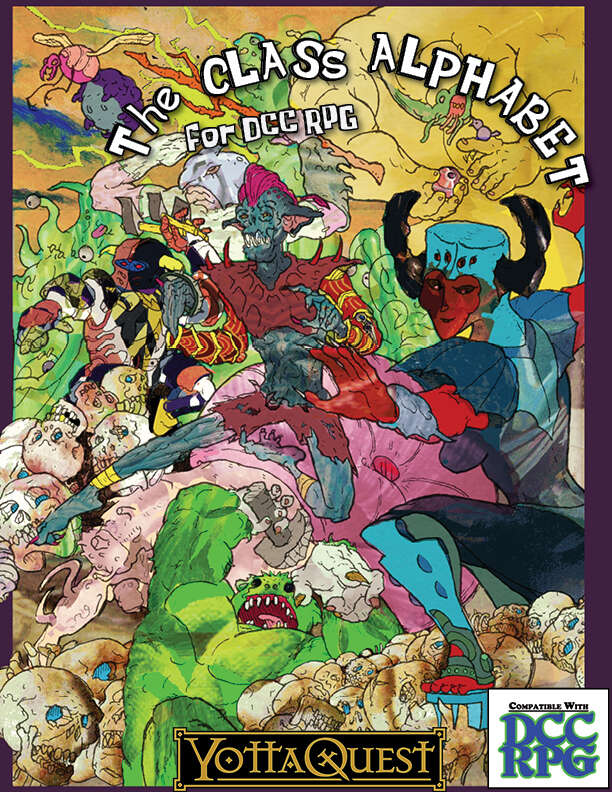
The Class Alphabet for DCC RPG

The Class Alphabet for DCC RPG was written by James V. West, Stephen Murrish, Anne Hunter, Victor Garrison, Jarrett Crader, David Baity, Julian Bernick, R.S. Tilton, Wayne Snyder, Claytonian, Diogo Nogueira, Noah Stevens, Jose SeldanaDavid Coppoletti, Jeff Goad, Jon Wilson, Reid San Filippo, Justin IsaacForrest Aguirre, Terra Fox, Anna Costa, and Rick Kammer. Art is by Danny Prescott, James V. West, Davey Parrott, Jane Elisabeth Thomas, David Coppoletti, Evlyn Moreau, Jon Wilson, R.S. Tilton, Claytonian, Diogo Nogueria, KJ O'Brien, David Lewis Johnson, Ray Otus, Karl Stjernberg, Anna Costa, and Rick Kammer. The publisher is Dungeon Remixer.

Disclaimer: I was given a free pdf from the publisher, in hopes that I would write about this product (which I would have anyway). As a result I noticed a few small edits prior to publication, which resulted in my being given a credit as an editor. My blog, Raven Crowking's Nest, is listed in Appendix III of this work.

This book, not surprisingly, contains an Introduction and a "How to use this book" section. Each is a single page long. Not all of the classes herein are going to fit well into every campaign. With 26 classes to choose from, the odds are that something will fit into any given milieu. None of these classes, however, is simply a Ranger or Paladin variant. Well, there is the Zealot....

For some reason, the publisher decided to make the pdf not only automatically default to a two-page spread, but treated those spreads as single pages. This is not ideal. Obviously, the two-page spread looks good - most pages are designed to take advantage of how one would see the pages in print - but it does make reading the pdf harder than it needs to be. At the point of this writing, a print version is not available.

Let's take closer a look at each of these classes, shall we?

A is for APE ASCENDANT: You are an ape. You are a very smart ape. You are a smart ape with primal strength and rage. You are a very smart ape with primal strength and rage that can deliver powerful psionic blasts. If you wanted to play an analogue of Gorilla Grodd, this is your chance. This is a relatively simple class to understand, taking only a single page of the book.

This class would fit into any tropical milieu with a bit of gonzo, but the PC might have a harder time visiting a tavern. This could also stand in for a yeti-type character, or a subset of Ith’n Ya’roo.

B is for BLACK CAT: Literally a magical black cat, this is nonetheless a fairly complex class which takes a full 12 pages to describe fully. The Black Cat gains spells, its own unique critical hit table, and a full patron write-up for Shammat, Lady of Cats. 

Most campaign milieus will include cats, and most societies are not at all surprised to see cats hanging around where people are. This class could gain wide usage as a result. Shammat might be an interesting patron for wizards and elves.

C is for CYBER-ZOMBIE: This class represents a dead body reanimated and upgraded with technology. Characters have to die in order to become Cyber Zombies, and not every dead character can be revived as such.

This is a complex character class that requires 7 pages to describe, including upgrades that the character might gain. In a milieu similar to Umerica or Mutant Crawl Classics, this class could fit right in. The class might be the result of PC action, or the result of technological processes beyond the characters' control - in this way, an adventure location could create Cyber Zombies as unique PCs even in a nominally medieval setting.

D is for DRUG USER: I am still amazed that Joseph Goodman let this one into the book.

A complex class taking 10 pages to describe, "You sacrifice your sanity to forces from beyond the cosmic veil in exchange for powers unknown in your birth universe. You walk a tightrope between controlling your environment and controlling yourself. If you let your guard down for just one unwary moment, or pursue an ecstatic experience just a little too far, you risk being invaded and ultimately consumed by Transdimensional Cognitive Parasites who skitter around the periphery of your reality, looking for a portal into a host consciousness in your dimension".

Ostensibly, this class could fit into almost any game setting, but including it will definitely change the tone of a campaign. Sadly, there is no mention of taduki.

E is for EDITOR: Taking up two pages, this class is designed with meta-gaming in mind. Serious meta-gaming. As in looking at the judge's notes and reporting back to the party meta-gaming. This might be fun in a one-shot, but I would have a hard time using it in an extended campaign. What else should one expect from "Jarrett Crader & accomplices"?

F is for FLESH-FORGED: This is a two-page re-imagining of Frankenstein's Monster, with an awareness that all of its parts might not actually be human. The class is relatively straight-forward and could fit into almost any milieu. With a little bit of disguise work, it might even be welcome in a tavern. I would limit the use of the class to prevent it from losing its impact.

G is for GOBLIN GANG: Another two-page class, you are literally a gang of small, imp- or gremlin-like goblins. Effectively, this is role-playing a swarm. Does it work? Well, the class is not difficult to understand, but it would have a hard time interacting with the mundane folk of your average village.

It would be easy to reskin this class to fit into almost any campaign milieu, although if the game is strongly human-centric it will not fit. They could be some form of collective intelligence in Star Crawl, Crawljammer, or Phantasmagoria. In Umerica or Mutant Crawl Classics, they would fit right in. In a game based around the Shudder MountainsDark Trails Weird Frontiers, or Transylvanian Adventures this class could represent an opponent, but probably will not be a comrade-in-arms.

H is for HELLFONT: Why allow wizards to have all the fun of demonic patrons and corruption? Now your Warrior-type character can have them too! Although not a complicated class, it does take 4 pages to also document the powers and corruptions you might have. I picture this class as being inspired by Venger from the old Dungeons & Dragons cartoon, but I could certainly be wrong.

If there are demonic patrons in your milieu, this class will fit. You might have trouble mingling with other folk, however,

I is for INTELLIGENT WEAPON: Here is an interesting idea: your PC is an intelligent weapon. This also means that you need a thrall...some feckless would-be adventurer that you can control and act through. It is a neat idea, taking three pages to detail, and is not overly complicated. Although a magical sword, axe, or hammer might be the go-to ideas that come to the average player, it would be easy to use this class in Mutant Crawl Classics, Star Crawl, or Umerica with a more technological base. Not every magical ability is easily converted to a technological ability, but transition should go smoothly with a little judicious interpretation.

J is for JOCKEY: This is a one-page class for those who might wish to ride some form of critter. It isn't complicated and, for the most part, it should translate easily to almost any game milieu. If  the idea of a PC mounted on an umber hulk is too gonzo for you, use sparingly!

K is for KNAVE: This is possibly the most complex class created for Dungeon Crawl Classics at the time of this writing. It is not surprising, then, that it takes a full 30 pages to fully describe. 

"Knaves are selfish in the extreme. They take what they want, and live off other people’s labor. Knaves take the largest slice of pie; they drink the whole pail of water. Knaves want the biggest and the best, the first pick, the choicest cut. They demand service and servitude, and anyone who stands against them gets beaten down full sore. Knaves blackmail and ambush, they burgle and break, they wheedle, they scheme, and they’ll fight to the death – but never lift a finger to do an honest day’s work."

What sets them apart, though, is service to the Arcana. The Knave has a mystical relationship to the tarot deck, They have a suit chosen from those of standard playing cards - Clubs, Spades, Diamonds, and Hearts - that helps to define their powers. In short, once more, they are complicated. Flavorful, but complicated. You will want to have this section printed out at the table if you play a Knave or have one in your game. 

Depending upon how your magic is styled, this class may or may not fit into your milieu. It would be perfect in a game inspired by Faerie Tales from Unlit Shores, but might seem out of place on the Purple Planet. Or not. It's your game.

L is for LEMURIAN: Another ape-themed class, this one being a man-ape with ancient memories but no overt psionics. Well, the picture shows a man-ape, but this could just as easily describe Brule the Spear-Slayer from Robert E. Howard's Kull stories, or some of the heroes of Lin Carter's more tongue-in-cheek Lemurian Cycle. The class is not complicated, clocking in at three pages. If your milieu includes ancient peoples in a primordial world, the Lemurians may do nicely.

M is for MONSTER TRAINER: Clearly inspired by Pokémon, this somewhat complicated class only takes three pages to describe. Unfortunately, the sample monsters from the Working Class Alphabet are not reproduced (so you had better get that as well...) but, then, anyone travelling in a DCC milieu is bound to encounter something worth catching.

Because of the obvious source of inspiration, this class might not fit into all milieus. However, the writing is good, and the class could fit into almost any game. 

N is for NINJA VAMPIRE: You are a ninja. You are a vampire. It takes two pages to describe what this means, because, after all, "Ninja Vampire" is not a hard concept to grasp. Whether or not your character fits into a particular campaign milieu is another matter. This class is particularly appropriate appearing in the ruins of Seattle in an Umerican campaign.

O is for OGRE: You are an ogre. It isn't that complicated. Your class takes three pages to describe because you get your own special crit table. You get that table because you are big and you like to bite things. There are probably a lot of campaign milieus where you can't get seated in a tavern.

P is for PUPPET MASTER: This class casts spells and controls puppets, which makes it rather like the villain of A. Merritt's Burn, Witch, Burn! This is not very complicated, but takes 3 pages to describe because the puppets themselves must be described. This class could fit into most settings.

Q is for QUANTUM WANDERER: "You are misplaced in time and space — lost, marooned, or simply not where you started — but in any case, you come from a world very different to the primitive one you find yourself on now. Though it must be said these primitives do keep finding ways to surprise you with their inventiveness. You may be moving on as soon as your etheric beam emitter is working again and your towel is dry, or perhaps this is where you’ve decided to settle long term. Or you may be searching this world high and low, in hopes of finding a way back to where you belong..."

This class takes three pages to describe and assumes that the PC comes from an advanced future. Appendix N fiction is filled with modern people become embroiled in other worlds, be they the past of their own world, or other worlds such as Mars or Venus. Here we are more into Kang the Conqueror or Booster Gold territory.

R is for RO-BARD: This is a robot entertainer. Although the class uses standard DCC class metrics, this is clearly a class that would fit well into the Umerican setting. It might also fit well in Star Crawl, Phantasmagoria, or Crawljammer. Not overly complicated, the class takes 3 pages to describe.

S is for SLIMENOID: A simple, single-page class that is also not likely to be welcome in the average tavern. "Mucal invader, is there no end to your oozing?!" Strangely, though, I could see this class working in most campaign milieus. In some, the Slimenoid would be an anomaly, but in a Mutant Crawl Classics game? Slime on!

T is for TENACIOUS D-FENDER: This is a three-page class dedicated to Tenacious D - effectively a parody of a parody. Nonetheless, it is a playable class...although playing one will very likely affect the tone of the game.

U is for UBIQUARIAN: "Everyone has wished they could be in two places at once, but the ubiquarian actually can—and some can even be in up to sixteen places at once!" It's an interesting idea for a class, and one that could fit into a great many campaign milieus. The class is not overly complex, and takes up three pages including a table for Astral Mishaps. Probably more importantly, the rules allow the class to do some unique things - including providing advanced scouting - but it should not overwhelm the table.

V is for VELOCIRAPTOR: A two-page description of a Velociraptor class. For other takes on similar classes see The Goodman Games 2017 Gen Con Program Book, Crawling Under a Broken Moon #14, Hubris, and Tales of the Fallen Empire. DCC players seem to have a thing for playing saurians. They are even part of Primal Tales.

W is for WOLF GIRL: "Bristling with primal energy, finely tuned to her territory, thriving on self-governance—the Wolf Girl is an unapologetic autarch, motivated by razor sharp instincts and a ferocious drive to survive. Her prevailing ideology is essentially solipsistic: preservation of self, and of the environs that sustain her. Threats to this paradigm are dispatched with swift brutality. Depending on her natural empathy, a Wolf Girl’s sense of self can expand to include friends and causes, which she will defend with exceptional displays of courage and sacrifice.

Wolf Girl has an inner wolf; she is a shifter, dominated by mood swings, focused anger, and unresolved trauma. Residing in the wild, she and her lupine companion are self-possessed, meditative, and stunningly savage. 

A Wolf Girl might use her connection with the earth to craft potent medicines, bezoars, and alchemical components. She might also be a master of her physical reality: platforming buildings, deflecting gunfire, and lancing targets from hundreds of yards away. Wolf Girl’s origins and motivations differ as well. The Wolf Girl is a paragon of natural balance."

This is a magical female Mowgli which takes two pages to describe. The Wolf Girl would fit into most campaign milieus, but would excel at outdoor adventuring away from the confines of both the city and the dungeon.  

X is for XENOCYTE: A two-page class that seems a bit Alien. There are game milieus into which this would fit (Star Crawl springs to mind), but I have a hard time imagining Xenocytes mingling in the tavern after an adventure, or carousing on the streets of Lankhmar.

Y is for YOUTHFUL MUSICIAN: "In every age, in every land, there have been those good souls who travel amongst the needy and who work to undo the machinations of evil. There is something about youth, exuberance, and transgressive music that stirs adolescence and young adults into travel and the championing of all that is good and right. Often, these foolhardy souls simply strive to right the wrongs caused by petty men and women against their neighbors, but every now and then they stymie the efforts of galaxy-spanning cults, supernatural beings, and weird entities from beyond the stars. They fight the good fight for the sheer reward of it, asking no recompense and wandering here and there living where the needs of Law might take them. They tend to attract weirdness of all kinds, and are frequently accompanied by talking animals, beneficent spirits, barmy obsolete robots, and all manner of other companions. Playing music is something of a side gig, or perhaps solving mysteries is the side gig - often there is no way to tell..."

This two-page class is inspired by Jeff Quick’s game Hijinx, appearing in Polyhedron #158. It is a joke class, like the Hot Dog Suit, which will definitely alter the tone of whatever game it appears in.

Z is for ZEALOT: The last class in the book is a two-page divine champion which is definitely promoting a single god. This should fit easily into most campaigns.

Appendices: The book also includes three appendixes. The first deals with esoteric rules and frequently asked questions. The second breaks down the classes into the in-game roles they fill. A discerning judge might reproduce the list from this chart to indicate which options are available in their game. An even more discerning judge might allow certain classes to become available as rewards for meeting certain Quest For It goals, or for playing through specific adventures. Finally, there is an appendix of resources, including an Alphabet of Game Worlds.

The Class Alphabet for DCC RPG introduces 26 NEW classes to your game. Each is fully playable from level 1 to 10, and there's a class for every letter of the alphabet! Within this book you will find a mythic proportion of options for any variety of game setting or playstyle. Every class has been lovingly handcrafted and lavishly illustrated by a team of gongfarming gamers from every corner of the globe. These classes will not only elevate your game to new heights of gonzo-infused frenzy, but will also inspire a multitude of ideas to help judges and players develop their own unique content.

Apes, robotic bards, quantum vagrants, shadow manipulators, monster trainers, puppet masters, ogres, dinosaurs, hellbound warriors, tenacious d-fenders, and gangs of goblins are JUST A FEW of the madcap character classes you'll discover inside. All completely illustrated with accompanying spells, crit tables, powers, and other bizarre tables of options.

Strap in, because your game is about to experience a paradigm shift and things may never again be the same!

Get It Here!


Tuesday, 6 February 2018

Peril on the Purple Planet

DCC #84: Peril on the Purple Planet is a 4th level adventure written by Harley Stroh. Art is by Doug Kovacs (including cover and cartography) and Stefan Poag. The publisher is Goodman Games.

DCC #84: Peril on the Purple Planet was published as a boxed set containing several other booklets and materials that could be used to bring the Purple Planet setting alive. These include:

#84A: Lost Tombs of the Ancients: More Purple Planet Adventures (Writers: Daniel J. Bishop, Tim Callahan, Edgar D. Johnson III, and Terry Olson. Art and cartography by Doug Kovacs.)

#84B: Purple Planet Companion: A Purple Planet Sourcebook (Writers: Daniel J. Bishop, Tim Callahan, Edgar Johnson, Terry Olson, and Harley Stroh. Art by Doug Kovacs [including cover], William McAusland, and Stefan Poag.)

#84C: Escape from the Purple Planet: A Level 0 Adventure (Writer: Harley Stroh. Art by Doug Kovacs [cover and cartography] and Michael Wilson.)

The Kith Critical Hit Chart

Peril on the Purple Planet Player's Guide

Purple Planet Book of Handouts

Purple Planet Judge Screen

In addition, “Author’s edition” boxed set came with a section of the Glossography of Ythoth, by Harley Stroh. You can read a discussion of it here on the Goodman Games forums.

Disclosure: I am the Daniel J. Bishop that wrote for #84A: Lost Tombs of the Ancients and #84B: Purple Planet Companion: A Purple Planet Sourcebook.

This adventure, and its additional contents, was the result of a very successful Kickstarter campaign. Author Harley Stroh discussed the campaign on Spellburn, which you can listen to here.

At the time of this writing, the Purple Planet is Goodman Games' best supported setting for Dungeon Crawl Classics. It has spawned three sequel adventures (The Rock Awakens, Synthetic Swordsmen of the Purple Planet, and Sky Masters of the Purple Planet) and has been linked to other adventures, such as Neon Knights. Given the amount of material in the box, and the level of support Goodman Games (and others) have given the setting, it should be no surprise that this will be a long listing.

In order to make the material more accessible, I am going to discuss each piece separately, below.

DCC #84: Peril on the Purple Planet

"In Peril on the Purple Planet, the characters are cast across the cosmos to a foreign world. Left to die beneath a weirdling sun, the PCs’ survival depends as much upon their quick wit as a quick blade, as even the finest chain hauberk must fail beneath the crush of an alien horde."

This is an epic adventure reminiscent of the Barsoom novels of Edgar Rice Burroughs, or any of the many imitators they spawned (including work by Robert E. Howard, Leigh Brackett, and Michael Moorcock!). PCs have to survive the conditions of their arrival, learn how to live upon a harsh world, and then find their way home...or attempt to master the Purple Planet itself!

The base adventure is part hexcrawl, part quest, and all learning how to survive. Harley Stroh came up with some incredible locations. Area C makes me wonder whether or not he is a Doctor Who fan. Like Gamma World before it, and Mutant Crawl Classics after, the adventure also deals with strange new devices, and PCs figuring out how to use them!

#84A: Lost Tombs of the Ancients: More Purple Planet Adventures

There are already suggestions in the basic adventure for creating ancient cairns and tombs on the Purple Planet (see pages 19-21). If you are going to run Peril on the Purple Planet in a campaign, though, or spend longer than a single adventure there, more is better. This booklet provides for this.

The adventures are:
  • The Tomb of Sotark the Destroyer: Awaken a sleeping bioweapon, and perhaps regret it. By Daniel J. Bishop. Notes: Sotark is named for Leigh Brackett's Eric John Stark, and the artifacts you may win are based on a well-known figure whose name is an anagram for Vance.
  • The Tomb of the Immortal Kahl: Speaking of John Eric Stark, this adventure shares some thematic ties with The Secret of Sinharat. Only the Immortal Kahl isn't Kynon, and this is no charade. By Terry Olson.
  • The Tomb of Dust: Solve a series of encounters to uncover a lost archive. This adventure can test the players as well as the characters, depending upon how you run the final test. By Edgar Johnson III.
  • The Bunker: Find a way to traverse two hexes while travelling underground. Notes are provided for creating other ancient Kith bunkers. By Daniel J. Bishop.
  • The Tomb of the Organon Magisteros: Explore an ancient air skiff platform, now overrun by insect-men. Discover an unexpected being trapped at its core. By Tim Callahan.

#84B: Purple Planet Companion: A Purple Planet Sourcebook

This supplement was written by Daniel J. Bishop, Tim Callahan, Edgar Johnson, Terry Olson, and Harley Stroh. Art is by Doug Kovacs (including cover), William McAusland, and Stefan Poag.

Within you will find:
  • Mysteries of the Purple Planet: Seventy-four mysteries to be used "as random encounters, encounter seeds, or the start of a new adventure."
  • The Ecology of the Kith: Everything you wanted to know about the kith but were afraid to ask.
  • Kith as Player Characters: Full race-class, including a d24 Occupations table.
  • Additional Kith Resources: A Random Kith Warband Generator and Fumbles Against Kith Hordes (because when you fumble facing a Kith horde, things are just not the same!).
  • Bestiary of the Purple Planet: Twenty-four new entries for your Purple Planet encounters.
  • Magic on the Purple Planet: Page 358 of the DCC core rulebook has a section entitled "Magic Here and Magic There". The Purple Planet doubles down on this advice...everything changes! Notes are given for all the patrons in the core rulebook, for casting spells in different geographical areas, Mercurial Magic that affects all casters, Purple Planet-specific corruption, how specific spells are changed, how clerics connection to their gods are affected, and more. The section on Techno-Magic might be particularly useful when running Crawljammer, Umerican, or Mutant Crawl Classics/Dungeon Crawl Classics crossovers.
  • The Purple Under-Planet: "The weirdling sun is a persistent obstacle on the Purple Planet’s surface, and PCs, like generations of ancient kith before them, may seek shelter deep below ground. This is the Purple Underplanet. Here lie ancient civilizations, some altered unrecognizably from their origins, others cloned to perfection. Sentient beings continental in scope vie for dominance." This section includes everything you need to create new adventures in depths beneath the Purple Planet. The less said here the better, as this should be Terra incognita to those venturing below.

#84C: Escape from the Purple Planet: A Level 0 Adventure

Written by Harley Stroh. Art by Doug Kovacs (cover and cartography) and Michael Wilson.

A 0-level adventure that allows you to start a campaign on the Purple Planet. The possibility of an all-kith party, a party from a typical DCC campaign world, or a party from our world, are considered. Appendix I: Interplanetary Heroes considers the possibility of modern heroes a bit more, but doesn't supply an occupation chart.

Possible modern, near-modern, or similar type characters might be gleaned from 50 ‘80s Teens for “Old School” Adventuring (in 50 Fantastic Functions for the D50); Beyond the Silver Scream; Black Powder, Black Magic Vol. 1 (Western); Crawling Under A Broken Moon fanzine #3 (post-Apocalyptic); Dark Seas (in The Gong Farmer's Almanac 2017 Vol 4), The Devil's Chapbook (discusses punks and vikings); Dinosaur Crawl Classics (in the Goodman Games Gen Con 2017 Program Book); Drongo: Ruins of the Witch Kingdoms; Not in Kansas Anymore (in the Goodman Games Gen Con 2016 Program Book); Null Singularity (because why not use Voidants?); Outlive, Outsmart, Outkill!; Rock God Death-Fugue (because, again, why not?); Transylvanian Adventures; Trench Crawl Classics (in  The Gong Farmer's Almanac 2017 Vol 7), or The Umerican Survival Guide (post-Apocalyptic).

The Kith Critical Hit Chart

Exactly what it says on the tin. This does not show up on the RPG Now link, but it is listed. I have sent an email to Joseph Goodman to see if it can be corrected.

Peril on the Purple Planet Player's Guide

A small booklet containing character sheets, a relic runes handout, a mostly-blank map handout, and places to keep notes on relics, mushrooms, creatures, and other things the PCs might encounter.

I am personally of two minds about this sort of thing. Blank maps (with high ground marked) and character sheets are fine. The other items - even the rune graphic - might be better to only make available as things are encountered. On the other hand, foreshadowing of some of the monster/relic images might be fun. Also, the Player's Guide might steer the PCs towards interacting with the mushrooms they encounter, which is fairly important.

Purple Planet Book of Handouts

A 12 page book containing 11 illustrations, one of which is of various kith, and another of which contains several kith standards. These, and an illustration of various relics the PCs might encounter, could be printed out (or copied) and then cut up to show the players only what they need to know. There is some duplication with the Player's Guide.

Purple Planet Judge Screen

Reproduces some charts you might want to keep handy. Having these printed out so that you can handle them as needed is actually more beneficial, in my opinion, then having them on a screen. If you have a physical copy, though, the screen can help to hide maps and notes.

Conclusion

In addition to the materials listed here:

  • The Gong Farmer's Almanac 2016 Vol 3 contains a big-mouthed alien who wanders the Purple Planet as the last of his kind as part of the Gazette-Fear (based on art by Doug Kovacs).
  • The Gong Farmer's Almanac 2016 Vol 4 contains The Orm Lies Down on Punjar. This is a Terry Olson adventure wherein the PCs somehow gain hold of a bottle of Purple Rhost (from Harley Stroh's Purple Planet).
  • The Goodman Games Gen Con 2015 Program Book contains Appendix F: The Ythoth Raider, an expansion of the Purple Planet Author’s Edition Glossography: This is the Ythoth Raider class by Harley Stroh, creator of the Purple Planet.
  • Neon Knights (by Brendan LaSalle) is also connected to the Purple Planet.

The Purple Planet: Where tribes of man-beasts wage an endless war beneath a dying sun. Where mighty death orms rule the wastes, befouled winds whistle through ancient crypts, and forests of fungi flourish in the weirdling light. Where ancient technologies offer life ... or a quick death.

Bereft of patron, friend or god, your survival depends on quick wits and a strong blade. Will you and your companions stand as conquerers atop this alien land? Or will you fall beneath the blast of an ink-black death rays, just another corpse left to litter the wastes of the Purple Planet?

Get It Here!